
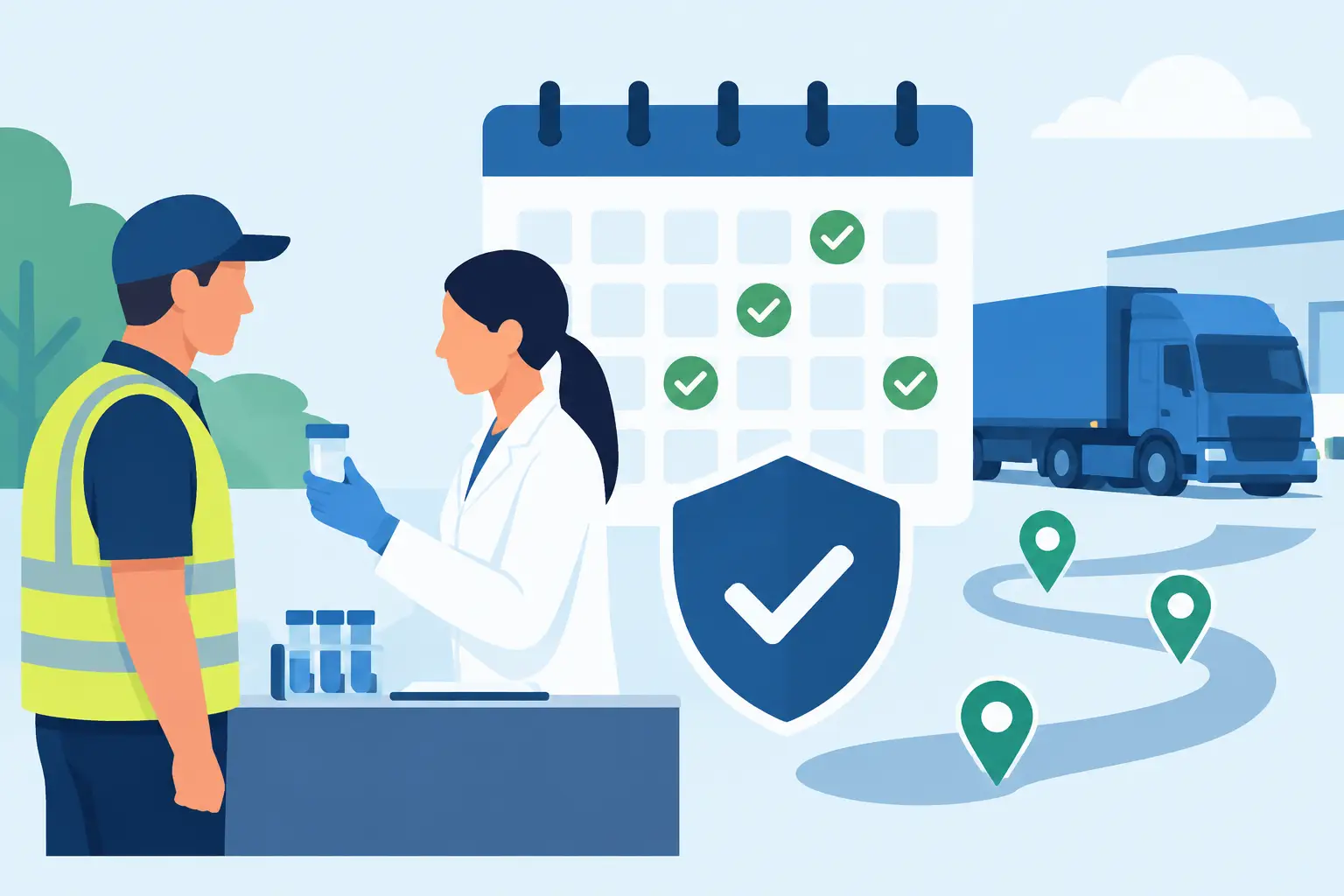
A missed random test can create more than an administrative problem. It can disrupt a driver’s schedule, expose an employer to audit findings, and raise questions about whether a safety-sensitive program is being administered as required. To manage DOT random testing effectively, employers need a documented process that keeps selections random, notifications discreet, testing timely, and records ready when requested.
For fleets, owner-operators, and safety-sensitive employers, the goal is not simply to order tests. The goal is to operate a program that holds up under regulatory review while keeping people and equipment moving.
Start With the Correct DOT Testing Pool
DOT random testing is administered by agency, not as one universal program. An employee covered by FMCSA must be in an FMCSA pool. An employee covered by FAA, FTA, FRA, PHMSA, or USCG must be included in the pool for the agency that governs their safety-sensitive work.
This distinction matters when an employer has multiple operations. A company may employ commercial drivers, transit personnel, and aviation staff, for example. Each group may be subject to different minimum annual random testing rates and program requirements. Combining employees into an incorrect pool can compromise the validity of the program, even if every employee was tested.
Before enrolling workers, confirm who performs DOT safety-sensitive functions, which agency applies, and whether each person is active, inactive, or no longer covered. Keep job descriptions and agency determinations on file. If an employee changes roles, their pool assignment should be reviewed promptly.
Consortium Pool or Standalone Pool?
Small employers and owner-operators often participate in a consortium or third-party administrator pool. This is usually the practical choice when there are not enough covered employees to make an employer-specific pool efficient. A properly managed consortium provides a larger testing population while preserving agency-specific compliance.
A standalone pool can make sense for larger employers that want direct administrative control, customized reporting, or internal coordination across several terminals. The trade-off is greater responsibility. The employer or its program administrator must maintain accurate rosters, conduct valid selections, track required testing rates, and document every action.
Either approach can work. What matters is that the pool is correctly structured and actively maintained.
Use a Scientifically Valid Random Selection Process
Random testing must be unpredictable. Employees cannot be selected because of appearance, rumors, performance concerns, or a supervisor’s preference. A compliant random process gives every covered employee an equal chance of selection each time names are drawn, including employees who were selected previously.
Selections must also occur throughout the calendar year. Testing the entire annual requirement in one month is not a random testing program. It is a scheduled event. Spreading selections across the year better supports the deterrent purpose of DOT testing and demonstrates that the program is operating continuously.
A reliable administrator should be able to show how selections were generated, the date of each draw, the employees included in the pool, and the applicable testing rate. Employers should not rely on a spreadsheet or an informal drawing method when a defensible random selection record is required.
DOT agencies establish annual minimum random testing rates, and those rates can change. Confirm the current requirement for each applicable agency before setting testing targets. Planning based on an outdated rate can leave the program short at year-end.
Keep Employee Rosters Current
Most random testing failures begin with a bad roster. If former employees remain in the pool, active workers may not have a genuine equal chance of selection. If new hires are omitted, the employer is not testing the full safety-sensitive population.
Create a routine for reporting hires, terminations, leaves of absence, role changes, and returns to safety-sensitive duty. For many employers, monthly roster reconciliation is appropriate. Larger or fast-moving fleets may need weekly updates. The right frequency depends on turnover and operational complexity, but waiting until the next random draw is too late.
Your roster should identify the employee, DOT agency, safety-sensitive status, work location if relevant, and any conditions affecting availability. It should also distinguish workers who are not currently performing covered duties. Accurate information allows the testing administrator to make correct pool decisions and gives the employer a clear audit trail.
Notify Selected Employees Without Delay
Once an employee is selected, notification should be made only when the employee is ready to report for testing. Advance warning undermines the unannounced nature of random testing and can create unnecessary operational risk.
Designate specific people who can receive selection notices and direct employees to testing. Dispatchers, supervisors, HR staff, and safety personnel may all have a role, but responsibilities should be clear. The notification process should protect confidentiality while ensuring the employee proceeds to the collection site immediately.
Do not let scheduling convenience turn a random test into a next-day appointment. If the selected employee is working, they should be directed to test as soon as practicable. If they are not performing safety-sensitive duties, follow the applicable agency requirements and your written policy. The details can vary by circumstance, which is why supervisors need clear instructions rather than improvised decisions.
Train Supervisors for Real-World Situations
Supervisors do not need to interpret laboratory results, but they do need to understand their role in the testing process. Training should cover how to deliver a notification, what information can be shared, how to arrange transportation when needed, and how to document a refusal or other issue.
They should also know the difference between random testing and reasonable suspicion testing. A supervisor who has contemporaneous observations of possible drug or alcohol use may need to initiate a separate process. That decision should never be disguised as a random selection.
Build Collection-Site Coverage Into the Plan
Testing access is an operational issue, especially for drivers who are away from their home terminal or working outside standard business hours. A program is only as effective as its ability to get a selected employee to an appropriate collection site without unreasonable delay.
Review where your employees actually work, not just where your headquarters is located. Long-haul operations, remote locations, cross-border activity, and after-hours schedules all require planning. A broad collection-site network and after-hours support can reduce delays when a random selection occurs on the road or late in a shift.
For alcohol testing, timing and qualified testing resources are particularly important. Employers should have a clear escalation path for situations involving unavailable sites, equipment issues, or an employee who cannot safely continue operating. Document the steps taken and obtain program guidance promptly when an exception or unusual circumstance arises.
Document Every Step of the Random Testing Cycle
A DOT random testing file should tell a complete story: who was in the pool, how selections were made, when the employee was notified, where testing occurred, and what follow-up was completed. If a record is incomplete, an auditor cannot assume the missing step happened.
Maintain selection reports, pool rosters, custody and control documentation, alcohol testing forms where applicable, employer notifications, and any records related to refusals or corrective action. Records should be stored securely and retained for the period required by the applicable DOT regulations.
Access should be limited to personnel with a legitimate need to know. Testing records contain sensitive information, and good compliance includes protecting employee confidentiality. A centralized reporting system can help employers avoid scattered emails, paper files, and unanswered questions during an audit.
Review Results and Program Performance Regularly
Do not wait for an audit to find out whether your random program is working. Review testing activity throughout the year against the required annual rate. Check whether selections are spread appropriately, whether all notices resulted in timely tests, and whether roster updates are reaching the program administrator.
A quarterly review is a practical cadence for many employers. Look for patterns such as repeated site delays, selected employees who are difficult to locate, or departments with inconsistent roster reporting. Those patterns often point to process problems that can be corrected before they become compliance findings.
If your operation includes Clearinghouse responsibilities, keep random testing administration separate from required Clearinghouse queries and reporting, while ensuring both processes are assigned to accountable staff. They are connected compliance obligations, but they are not interchangeable.
Manage DOT Random Testing With a Clear Owner
The strongest programs have a named internal owner, even when a C/TPA manages the day-to-day administration. That person does not need to do every task. They do need to confirm that rosters are accurate, selection notices are received, documentation is available, and exceptions are addressed quickly.
WOOTS can support employers with DOT agency-specific pools, collection-site coordination, reporting, and responsive program administration. The right support model depends on your workforce size, locations, agency coverage, and internal compliance capacity.
A well-managed random testing program should feel routine to your team and difficult to challenge in an audit. Put the process in place before the next selection arrives, then make every handoff clear enough that no test is delayed, missed, or left undocumented.









Leave A Comment