
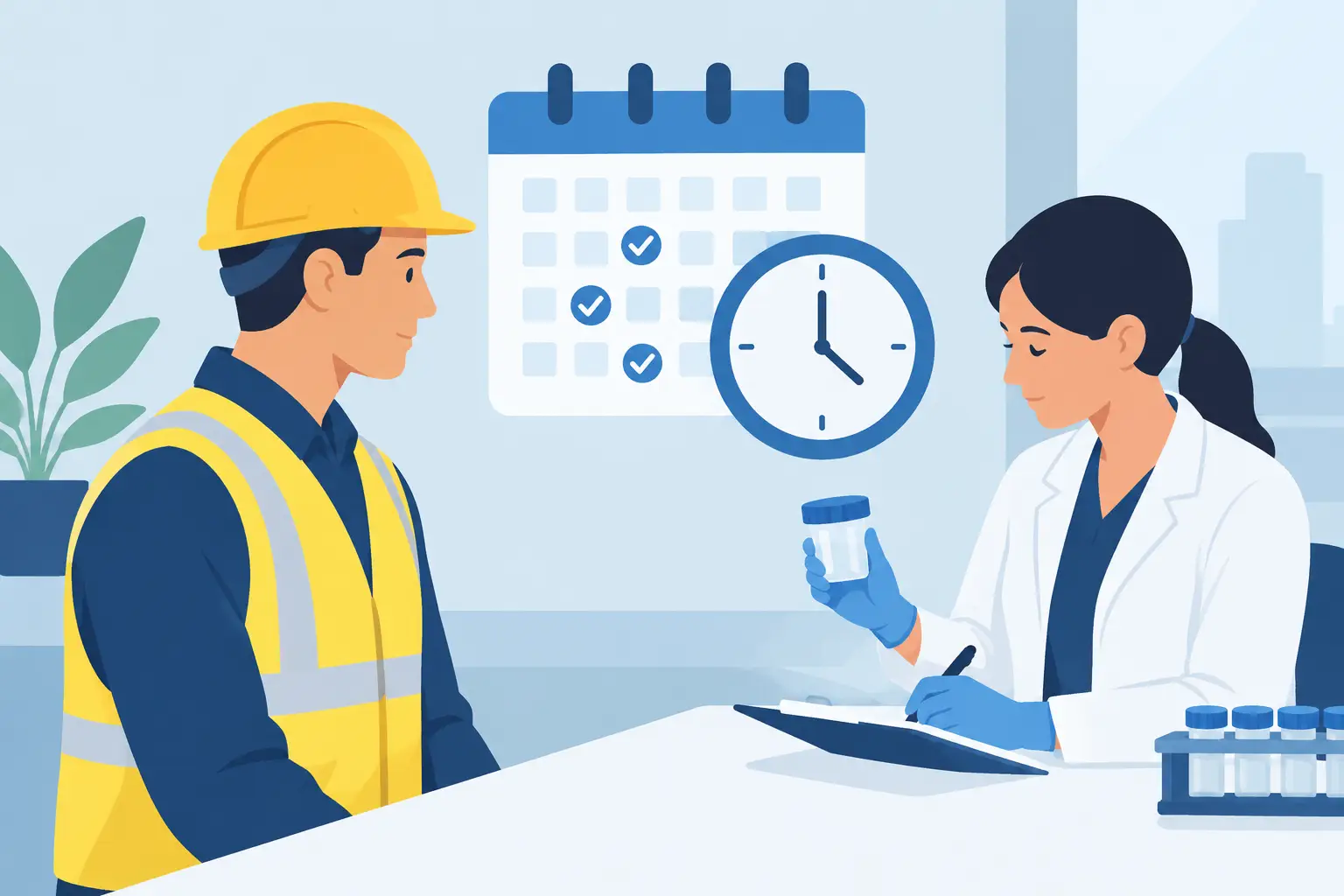
A missed test deadline can become more than an administrative problem. It can interrupt operations, expose an employer to enforcement risk, and leave a safety-sensitive employee unable to perform covered duties. DOT testing frequency is not one fixed schedule. It depends on why the test is required, which DOT agency regulates the employee, and whether the employee has a prior testing violation.
For employers, fleet managers, and owner-operators, the practical goal is simple: know which testing events are triggered, maintain a defensible random program, and act quickly when post-accident or reasonable suspicion testing is required. A compliant program should make testing routine where it can be planned and immediate where regulations require a rapid response.
DOT Testing Frequency by Test Type
DOT drug and alcohol testing rules apply to employees performing safety-sensitive functions for covered employers. These rules affect commercial motor vehicle drivers, aviation employees, transit workers, railroad employees, pipeline and hazardous materials workers, and certain maritime personnel. The core test types are consistent across DOT programs, but agency-specific rules and annual random testing rates can differ.
Pre-employment testing
A negative DOT drug test is required before an employee first performs a DOT safety-sensitive function for an employer. This is a one-time requirement for that hiring or onboarding event, not an annual test.
An employer may rely on a qualifying prior DOT drug test in limited circumstances if regulatory conditions are met, including verifying the employee’s prior testing history as required. Many employers choose to conduct a new pre-employment test because it creates a clear, current record before assigning safety-sensitive work. Alcohol testing is not required for DOT pre-employment purposes, although an employer may include it under a separate company policy where permitted.
The key operational point is timing: do not allow the employee to begin covered work until the pre-employment requirement has been satisfied. A pending result is not a clearance to operate.
Random testing
Random testing is the part of DOT testing frequency that requires the most ongoing administration. Covered employees must be placed in a scientifically valid random selection pool and remain eligible for selection throughout the year. Selections must be unpredictable, and every employee in the pool must have an equal chance of being selected each time a drawing occurs.
The DOT sets annual minimum random testing rates as a percentage of the average number of safety-sensitive positions in an employer’s pool. Each DOT agency establishes its own drug and alcohol rates, and those rates can change from year to year based on industry-wide testing data. Employers should confirm the current rate for their specific agency before setting their annual testing plan.
A random rate is not a limit on how often one person can be selected. An employee may be selected more than once in a year, including in consecutive selection periods. Another employee may not be selected at all. Trying to spread selections evenly among individuals defeats the purpose of a random program.
Random tests must also be reasonably distributed across the calendar year. Completing most or all random tests in one month, then doing nothing for the remainder of the year, creates an avoidable compliance concern. Quarterly or monthly selection periods often make administration easier, provided the program reaches the required annual rate and selections remain valid.
Post-accident testing
Post-accident testing is triggered by qualifying events, not by a recurring calendar interval. For FMCSA-regulated drivers, the testing requirement depends on the type of crash, whether a fatality occurred, whether a vehicle was towed or someone required immediate medical treatment away from the scene, and whether the driver received a moving traffic citation.
When alcohol testing is required, it should be conducted as soon as practicable and generally within eight hours of the accident. Drug testing should also occur as soon as practicable and generally within 32 hours. If testing cannot be completed within the applicable timeframe, the employer must document why.
The employee should not delay necessary medical care to complete a test. Likewise, an employer should not treat every incident as automatically qualifying. A documented post-accident decision process helps prevent both missed required tests and unnecessary testing.
Reasonable suspicion testing
Reasonable suspicion testing has no set frequency because it is based on specific, contemporaneous observations. A trained supervisor must observe signs, symptoms, or indicators consistent with drug use or alcohol misuse. A rumor, a personality conflict, or a general impression is not enough.
For alcohol testing, the observations must be made during, just before, or just after the employee performs safety-sensitive duties. Drug testing may occur based on qualifying observations at any time. Employers need trained supervisors available across shifts, especially where employees work nights, weekends, or remote routes.
Return-to-duty and follow-up testing
A DOT violation changes the testing schedule. An employee who tests positive, refuses a test, or otherwise violates DOT drug and alcohol rules must be immediately removed from safety-sensitive functions. Before returning to covered work, the employee must complete the return-to-duty process with a qualified Substance Abuse Professional, or SAP, and receive a negative return-to-duty test.
Follow-up testing is then required under the SAP’s written plan. The plan must include at least six unannounced follow-up tests during the first 12 months after the employee returns to safety-sensitive work. The SAP may require follow-up testing for up to 60 months. These tests are separate from random testing, so the employee remains in the random pool as well.
How to Build a Defensible DOT Testing Schedule
A compliant program starts with an accurate list of covered positions. Count employees based on the safety-sensitive functions they perform, not just their job titles. A driver who occasionally operates a commercial motor vehicle may still need to be in the FMCSA random pool if the role is covered. Employees who no longer perform covered work should be removed promptly so the pool remains accurate.
Next, separate employees by DOT agency. An FMCSA driver should not be placed in an FAA or FTA pool simply because the organization operates in more than one regulated sector. Each agency has its own program requirements, random testing rate, and reporting expectations. Employers using a consortium or third-party administrator should still verify that workers are assigned to the correct pool.
Then, set selection periods that support year-round testing. Monthly selections can create a steady workflow for larger fleets. Quarterly selections may be practical for smaller employers. The better option depends on workforce size, turnover, operating hours, and collection-site access. What matters is that the plan produces valid, unannounced selections throughout the year.
Keep clear records of each selection, notification, test result, reason for testing, and any inability to test within a required post-accident timeframe. Records should show that the employer acted promptly and consistently. For FMCSA-regulated employers, Clearinghouse queries and violation reporting are separate obligations that should be coordinated with the testing process, not handled as an afterthought.
Common DOT Testing Frequency Mistakes
The most common mistake is treating the annual random rate as a per-employee requirement. If an agency’s annual rate is 50 percent, that does not mean each employee receives one test every two years. It means the employer must conduct a number of random tests equal to at least 50 percent of the average covered workforce during the year, using a valid random process.
Another frequent issue is testing after giving too much notice. Once notified of a random selection, an employee should proceed to testing immediately. Allowing an employee to finish a route, return home, or wait until the next day can undermine the requirement unless a legitimate operational reason applies and is documented.
Employers also create risk when they mix DOT and non-DOT testing rules. A non-DOT program may have different substances, collection procedures, consequences, or testing triggers. Keep DOT testing records, forms, and decision-making separate from employer-driven testing programs.
For companies with cross-border operations, this distinction matters. Canadian workplace testing policies do not replace US DOT requirements when an employee performs a US DOT-covered safety-sensitive function. The applicable regulatory role determines the testing framework.
Make Testing Frequency Operational, Not Reactive
The strongest DOT program does not wait for an audit, a crash, or a positive test to reveal gaps. It assigns ownership for pool updates, random selections, supervisor training, after-hours response, and record retention. It also gives dispatchers and supervisors clear instructions for what to do when a test is required outside normal business hours.
A qualified C/TPA can reduce the administrative burden by managing random pools, coordinating access to collection sites, supporting post-accident response, and organizing reporting by DOT agency. WOOTS helps regulated employers put those moving parts into a practical, documented process.
The right testing frequency is the one that follows the applicable rule every time, even when the employee is on the road, the incident happens after hours, or the workforce changes without warning.








Leave A Comment