
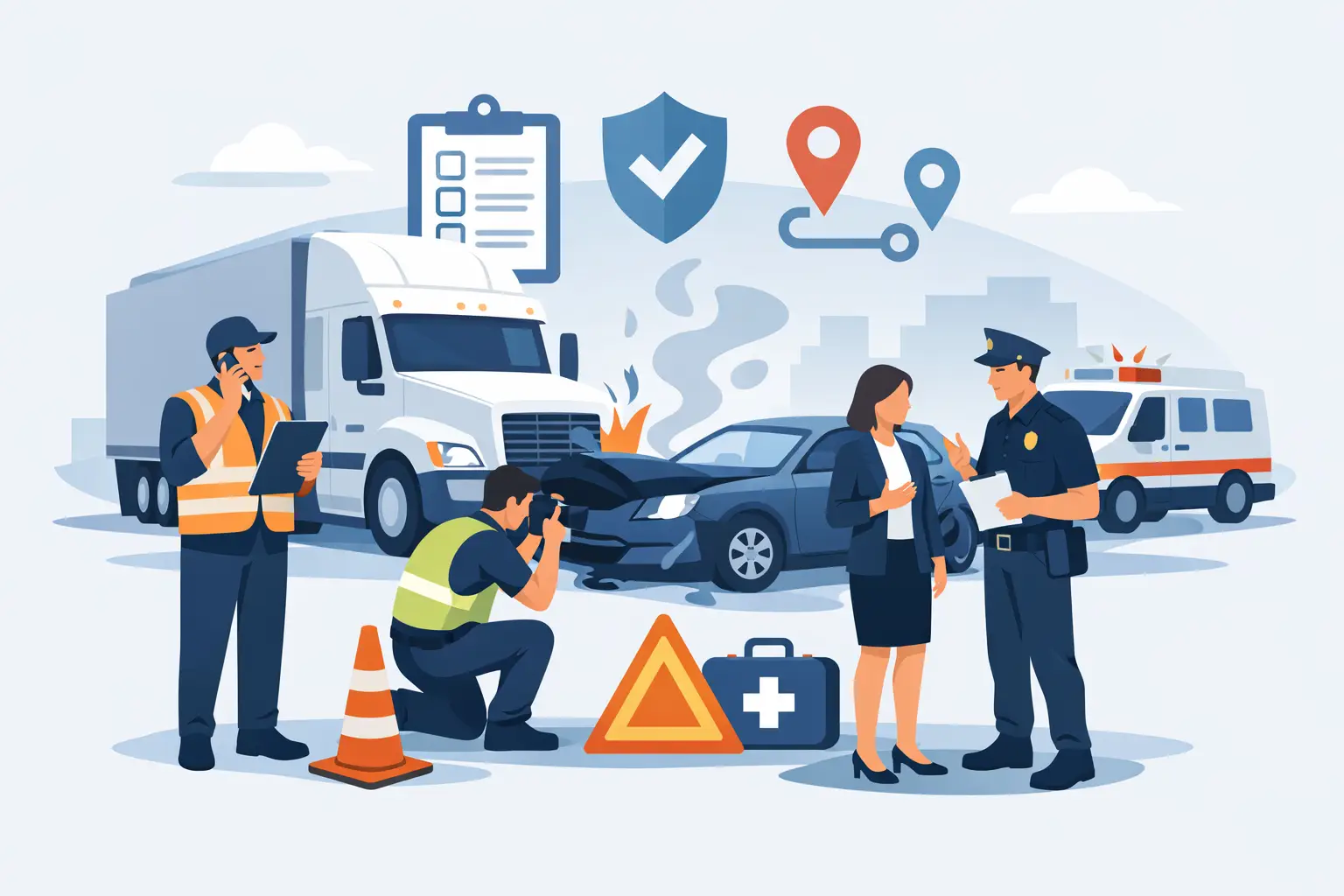
A collision can turn a normal dispatch day into a compliance event within minutes. The best post accident response steps protect injured people first, then help your team make a timely, defensible testing decision without adding confusion at the scene. For DOT-regulated employers, preparation matters because the clock for alcohol and drug testing begins immediately, while the facts needed to determine whether testing is required may still be developing.
A written post-accident process gives drivers, supervisors, dispatchers, and safety managers clear responsibilities. It also reduces the risk of missed tests, incomplete records, inconsistent decisions, and avoidable downtime.
Start With Safety, Emergency Response, and Scene Control
The driver’s first responsibility is to stop safely, assess injuries, call emergency services when needed, and follow local reporting requirements. No testing obligation takes priority over emergency medical care. A driver who needs treatment should receive it promptly, and a supervisor should never direct someone to delay care to complete a test.
Once immediate hazards are controlled, the driver should notify dispatch or the designated company contact. That call should trigger the company’s post-accident protocol, not an improvised series of messages between people who may not know the applicable DOT rules.
The initial report should capture the location, time, vehicles involved, injuries, whether a vehicle was towed, law-enforcement involvement, citations issued, and the driver’s current condition. These details are operationally useful, but they also help the employer determine whether DOT post-accident testing is required.
Determine Whether DOT Testing Is Required
Not every crash triggers DOT post-accident testing. The correct decision depends on the DOT agency that regulates the employee and the facts of the event. Employers should avoid two common mistakes: automatically testing after every minor incident or failing to test because the damage initially appears limited.
For FMCSA-regulated commercial motor vehicle operations, post-accident testing is generally required after an accident involving a vehicle with a fatality. Testing may also be required when a person receives immediate medical treatment away from the scene or when one or more vehicles are towed from the scene due to disabling damage, if the covered driver receives a citation under state or local law for a moving traffic violation arising from the accident.
Other DOT agencies, including the FAA, FTA, FRA, PHMSA, and USCG, have their own definitions, thresholds, and reporting expectations. A one-size-fits-all policy can create gaps for organizations with mixed operations. Your protocol should identify the governing agency, the employee’s safety-sensitive function, and the person authorized to make the testing determination.
If the information is incomplete, document what is known, continue gathering facts, and escalate the decision to your designated compliance contact. A quick, well-documented determination is better than a delayed assumption.
Initiate Testing Without Missing the Time Windows
When DOT testing is required, speed and coordination are critical. DOT alcohol testing should be completed as soon as practicable, generally within eight hours of the accident. DOT drug testing should be completed as soon as practicable, generally within 32 hours. These are not deadlines to wait for. They are outer limits, and the employer must make reasonable, documented efforts to test as early as possible.
The employee should be directed to a qualified collection site or testing resource. If the driver is away from the home terminal, after-hours support and broad collection-site access can make the difference between a completed test and a preventable compliance problem. The employer should provide clear instructions, confirm the collection location, and maintain communication until the testing process is complete.
A law-enforcement alcohol or drug test may sometimes satisfy a DOT post-accident testing requirement if it meets applicable conditions and the employer can obtain the necessary documentation. That does not mean a company should assume outside testing will cover its obligation. Confirm the result type, testing authority, timing, and records before relying on it.
If alcohol testing cannot be completed within two hours, document why. If it cannot be completed within eight hours, stop attempts and prepare the required record of the reasons. If drug testing cannot be completed within 32 hours, stop attempts and document why testing was not completed. Your records should show active effort, not merely a final outcome.
Keep the Employee From Performing Safety-Sensitive Work
An employee who is subject to post-accident alcohol testing must not perform safety-sensitive functions for at least eight hours following the accident, or until an alcohol test is completed, whichever occurs first. This restriction should be part of the supervisor’s immediate checklist, especially when a vehicle can be repaired quickly or a driver is eager to continue the route.
Operational pressure is understandable, but sending an employee back to safety-sensitive work before the restriction ends can create serious compliance exposure. Arrange a replacement driver, alternate transportation, or a temporary service adjustment. Build these options into the response plan before an accident occurs.
The company should also apply its own reasonable-cause procedures, fitness-for-duty protocols, and incident-review practices where appropriate. Those actions must be handled separately and consistently. A post-accident test is not a substitute for managing an employee who appears impaired, injured, or unable to safely perform duties.
Preserve Facts and Document Every Decision
The test result is only one part of the post-accident file. A complete record supports your compliance position, insurance coordination, internal review, and any future audit. The file should be organized while details are fresh, not reconstructed weeks later from emails and memory.
Maintain the accident report, driver statement, dispatch notes, photographs when available, police report information, citation details, towing information, medical-treatment facts known to the employer, testing authorization, chain-of-custody records, test results, and documentation of any testing delay or non-completion. Record the name and title of the person who decided whether testing was required, along with the basis for that decision.
Be precise with language. “No test required” is not enough. State the applicable DOT rule or company policy and the facts that led to the decision. For example, an FMCSA record may explain that no fatality occurred, no person was transported for immediate medical treatment away from the scene, and no disabling damage tow with a qualifying citation was reported. If later facts change the analysis, document when the new information became available and what action followed.
Train the People Who Receive the First Call
Drivers need a simple card or mobile-ready instruction sheet they can use under stress. Supervisors and dispatchers need more detailed training because they must recognize a potential post-accident event, protect the testing window, and avoid giving incorrect instructions. The first person who answers the phone often determines whether the response stays on track.
Training should cover how to report an accident, when to contact emergency services, who makes the testing decision, how to access after-hours collection support, and how to keep the employee out of safety-sensitive duties when required. It should also cover what not to do: do not speculate about fault, do not promise that a test is or is not required before facts are reviewed, and do not tell an injured employee to postpone medical care.
A practical exercise is more valuable than a policy acknowledgment alone. Walk through a nighttime accident, an out-of-state collision, an event involving a tow, and an accident where police do not issue a citation at the scene. Each scenario exposes different pressure points in the process.
Review the Event and Strengthen the Program
After the immediate response is complete, review the process without treating every incident as a disciplinary exercise. Ask whether the driver knew whom to call, whether the supervisor made a timely decision, whether the collection site was accessible, and whether documentation was complete. Look for system failures as well as individual errors.
For employers managing multiple terminals, owner-operators, or several DOT agencies, centralized program support can simplify this review. A compliance partner such as WOOTS can help coordinate testing access, documentation workflows, reporting, and supervisor training so local teams are not left to interpret a high-pressure event alone.
The most effective post-accident plan is the one your team can execute at 2:00 a.m., far from the terminal, with incomplete facts and real safety concerns on the line. Put the decision tree, contacts, testing access, and documentation process in place now, so your people can respond calmly when it matters most.

[…] non-DOT employer test where lawful and supported by policy. It cannot take the place of a required DOT post-accident or reasonable-suspicion urine drug test. Timing requirements for DOT testing still […]