
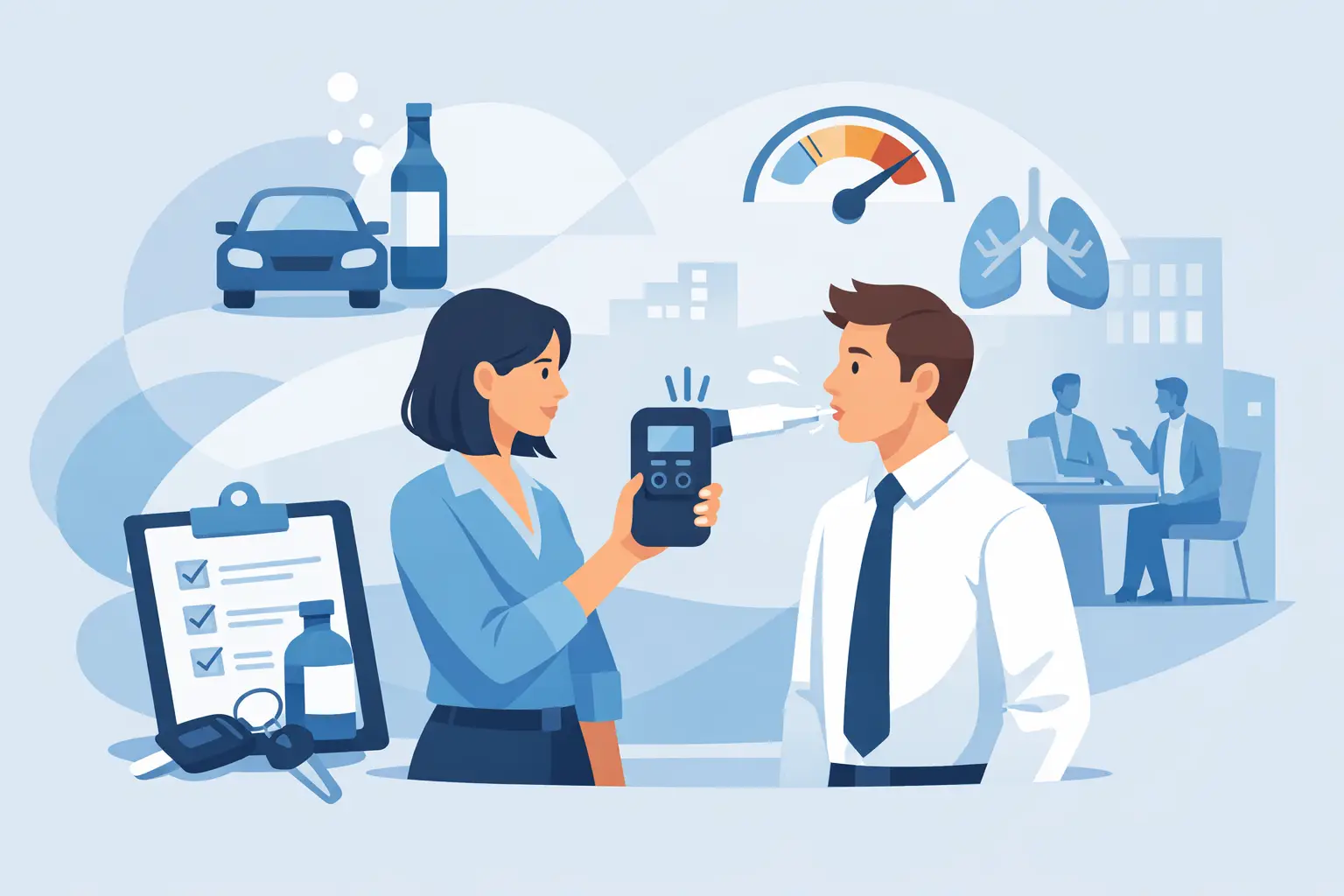
A breath alcohol test can affect a driver’s duty status, a fleet’s safety record, and an employer’s compliance exposure within minutes. Knowing how to conduct breath alcohol testing means more than handing someone a device. For DOT-regulated testing, every step – from the reason for testing through documentation and employee instructions – must follow 49 CFR Part 40 procedures.
This guide is written for employers, safety managers, supervisors, and program administrators who need a practical view of a compliant testing process. DOT testing must be performed by qualified personnel using approved equipment. Employers should not ask untrained supervisors to administer a test or make their own judgment call based on appearance, odor, or behavior alone.
Start With a Valid Reason for the Test
Before arranging a breath alcohol test, confirm why it is being ordered and which rules apply. Under a DOT program, testing may be required for pre-employment, random, reasonable suspicion, post-accident, return-to-duty, or follow-up purposes. The applicable DOT agency can add requirements, particularly for post-accident testing and reasonable suspicion determinations.
For reasonable suspicion alcohol testing, the decision must be based on specific, contemporaneous observations about an employee’s appearance, behavior, speech, or body odor. A trained supervisor must make and document those observations. Suspicion cannot be based on a rumor, a personality conflict, or a prior test result.
Timing matters. DOT alcohol testing for reasonable suspicion should occur only while the employee is performing safety-sensitive functions, just before performing them, or just after performing them. Post-accident alcohol testing has strict timing expectations as well. Employers should activate their response plan immediately rather than wait until the next business day.
A non-DOT workplace test may follow a different policy and legal framework. Canadian employers, multi-jurisdictional employers, and employers with non-regulated workers should ensure their written policy, testing rationale, privacy practices, and collection procedures fit the applicable laws and labor obligations. Do not apply DOT procedures automatically where they do not govern, but do not substitute a workplace policy for DOT requirements when they do.
Use Qualified Personnel and Approved Equipment
DOT breath alcohol testing is conducted by a qualified Breath Alcohol Technician, or BAT, using an evidential breath testing device, commonly called an EBT. A Screening Test Technician, or STT, may perform a screening test using an approved alcohol screening device, but confirmation testing has additional requirements.
The collection site must protect the integrity of the process and provide enough privacy for the employee. The technician verifies the employee’s identity, explains the procedure, completes the federal alcohol testing form, and checks that the device is operating properly. The employee should be treated professionally throughout the process. Respectful handling supports cooperation, but it does not mean bypassing a required step.
Employers should coordinate testing through a qualified collection network rather than rely on consumer breathalyzers, office devices, or unverified mobile testing arrangements. A personal breathalyzer may be useful for awareness, but it is not a DOT test and cannot establish a compliant result.
Conduct the Screening Test Correctly
The screening test is the first official breath alcohol test. The technician instructs the employee to provide a breath specimen into the approved device, then records the result on the required form.
A screening result below 0.02 is considered negative under DOT procedures. The technician provides the employee with the appropriate copy of the form, and the testing event is complete unless another issue requires follow-up.
A screening result of 0.02 or greater requires a confirmation test. The employee cannot simply leave, retest later by preference, or use a different device to challenge the result. The confirmation test is the official next step and must be handled under the required procedure.
The technician must observe a minimum 15-minute waiting period before the confirmation test. During that time, the employee must not eat, drink, smoke, place anything in their mouth, or belch to the extent practicable. This waiting period helps prevent mouth alcohol from affecting the confirmation result.
Complete the Confirmation Test
The confirmation test must be performed using an EBT that provides a printed result. It should take place as soon as possible after the 15-minute waiting period. If a confirmation test cannot be completed within 30 minutes of the screening test, the technician documents why.
The employee provides a second breath specimen, and the technician records the confirmation result. For DOT purposes, the confirmation result is the result that determines the outcome. A confirmation result below 0.02 is negative, even if the screening result was 0.02 or higher.
A confirmed alcohol concentration of 0.02 to 0.039 is not a DOT violation, but the employee must be removed from safety-sensitive duties for at least 24 hours. The employer must also follow any stricter company, collective bargaining, or agency-specific requirements that apply.
A confirmed result of 0.04 or greater is a DOT alcohol violation. The employee must be immediately removed from safety-sensitive functions. Before returning to those duties, the employee must complete the DOT return-to-duty process, including an evaluation by a qualified Substance Abuse Professional, required education or treatment, a follow-up evaluation, a negative return-to-duty test, and follow-up testing.
If an employee refuses to test, the employer must treat the refusal as a DOT violation. Refusals can include failing to appear, failing to remain at the site, failing to provide sufficient breath without an adequate medical explanation, refusing to sign required documents, or not cooperating with the testing process. Do not label a situation a refusal casually. Document the facts and consult the program administrator or compliance provider promptly.
Protect the Employee and the Record
After the test, the employer’s role is to act on the verified result, protect confidential information, and preserve records. Test results should be shared only with people who have a legitimate business need to know, such as a designated employer representative, compliance personnel, and other parties permitted under DOT rules.
The record should clearly show the testing reason, date and time, collection location, result, actions taken, and any unusual circumstances. For reasonable suspicion testing, retain the supervisor’s written observations. For post-accident testing that was not completed within the expected time frame, document why testing was delayed or could not occur.
DOT record-retention periods vary by document and result. Employers must maintain alcohol testing records in a secure location and be able to produce them during an audit. Disorganized files create unnecessary risk, especially when a carrier is facing an investigation, a DOT review, or litigation after an accident.
For FMCSA-regulated employers, alcohol violations must also be reported to the Drug and Alcohol Clearinghouse as required. A confirmed alcohol concentration of 0.04 or greater and a refusal to test are reportable violations. A 0.02 to 0.039 result is not a Clearinghouse violation, though the employee still cannot perform safety-sensitive duties for the required 24-hour period.
Train Supervisors Before an Incident Happens
A compliant testing process depends on decisions made before the employee reaches the collection site. Supervisors need training on recognizing alcohol misuse indicators, documenting observations, removing an employee from safety-sensitive work, arranging transportation when needed, and protecting confidentiality.
They should also know what not to do. Supervisors should not diagnose impairment, debate the employee at length, drive the employee themselves if that conflicts with company policy, or allow the employee to continue safety-sensitive work while waiting for a test. If there is an immediate safety concern, secure the work area first and follow the employer’s emergency response process.
A written post-accident and reasonable suspicion plan makes these situations far easier to manage. It should identify who authorizes testing, who contacts the testing provider, how after-hours service is accessed, how transportation is arranged, and where documentation is stored. WOOTS helps employers coordinate these operational details across DOT and workplace testing programs, including when a test is needed outside normal office hours.
Build Testing Into Your Compliance Process
Breath alcohol testing works best when it is part of a documented program, not an improvised response. Keep current contact information for designated employer representatives, maintain supervisor training records, review testing pools and random selections, and confirm that collection site access is available where employees actually work.
The most effective next step is to test the process before a real incident forces the issue. Walk through a reasonable suspicion scenario and a post-accident scenario with your safety team. If no one can quickly answer who calls, where the employee goes, what gets documented, and who receives the result, the plan needs attention before it becomes a compliance problem.



Leave A Comment