
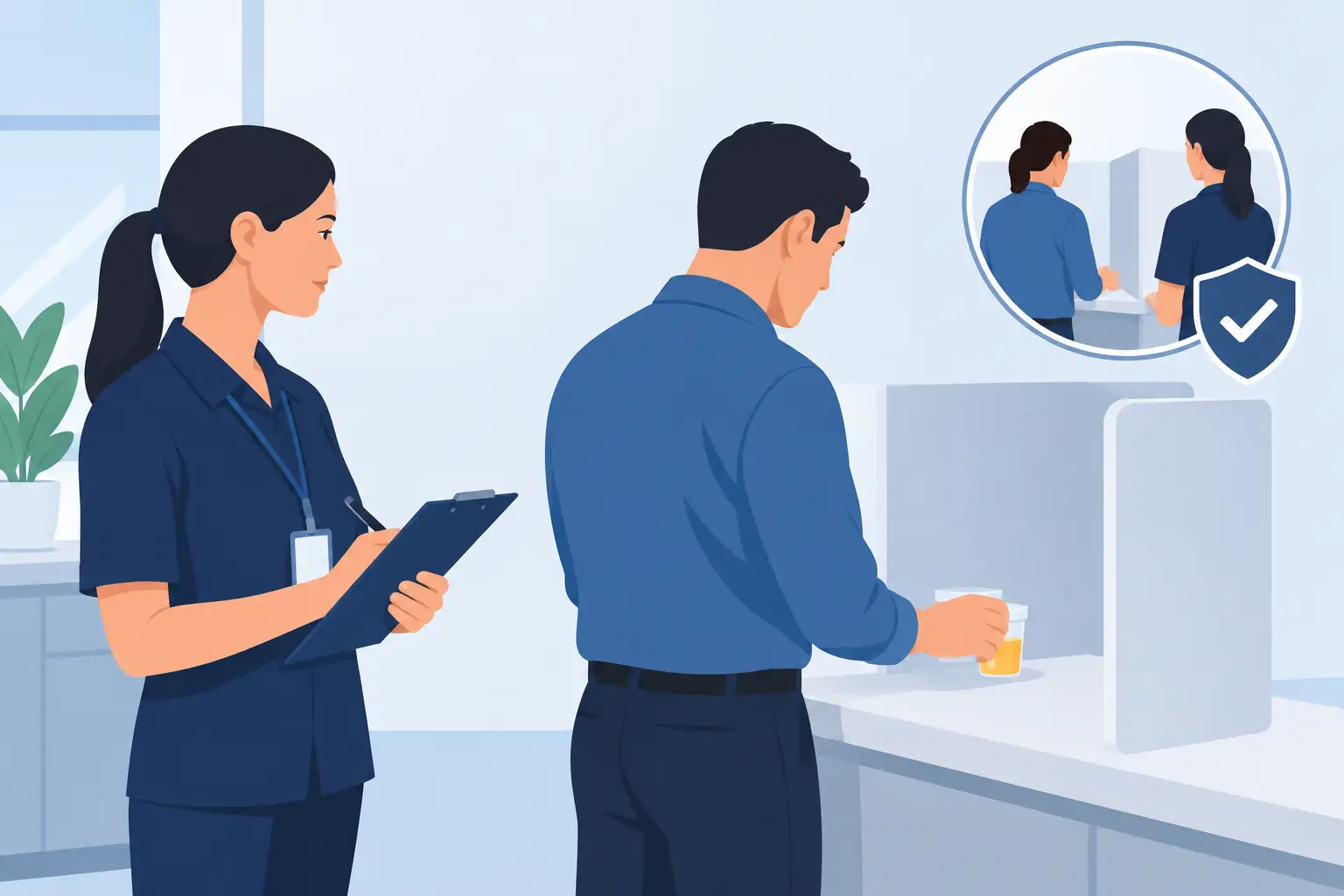
A collector tells an employee that the next urine specimen must be provided under direct observation. The employee is upset, the supervisor wants answers, and the testing process cannot be delayed. Knowing when is observed collection required helps employers respond correctly without compromising the employee’s dignity, the chain of custody, or the defensibility of the test.
For DOT-regulated employers, observed collection is not a routine management choice. It is a specific procedure governed by 49 CFR Part 40 and the rules of the applicable DOT agency. It applies to urine drug collections, not standard breath alcohol testing. The purpose is to protect the integrity of a specimen when there is a defined reason to believe an unobserved collection may not be reliable.
When Is Observed Collection Required Under DOT Rules?
A directly observed urine collection is required for all DOT return-to-duty and follow-up drug tests. These tests are part of the employee’s SAP-directed process after a DOT violation and cannot be completed as routine, unobserved collections.
Direct observation may also be required when the collection process or a medical review result creates a concern about specimen validity. Under Part 40, employers and collectors must follow the reason for observation that applies to the specific situation. The most common triggers include:
- A return-to-duty drug test after the employee has completed the required SAP evaluation and treatment or education process.
- A follow-up drug test required by the employee’s follow-up testing plan.
- A specimen temperature that is outside the required range of 90 to 100 degrees Fahrenheit within four minutes of collection.
- Conduct or physical evidence that clearly indicates an attempt to tamper with or substitute a specimen.
- A cancelled test resulting from an invalid specimen when the Medical Review Officer reports that no adequate medical explanation exists.
- A negative-dilute result with a creatinine concentration of at least 2 mg/dL but no more than 5 mg/dL, when the employer is required to direct a recollection.
The details matter. A test is not automatically observed simply because it is post-accident, reasonable suspicion, pre-employment, random, or return-to-work following a non-DOT company policy. Unless another DOT rule or a valid Part 40 trigger applies, those collections are generally conducted using the standard procedure.
Return-to-Duty and Follow-Up Testing Are Always Observed
Return-to-duty and follow-up testing are the most straightforward cases. Once an employee has violated a DOT drug and alcohol testing regulation, the Substance Abuse Professional determines the employee’s required education or treatment and establishes the follow-up testing plan. The employer is responsible for carrying out that plan.
Every DOT return-to-duty drug test must be directly observed. Every DOT follow-up drug test must also be directly observed. This requirement applies even when the employee has been cooperative, has a long service record, or has previously produced valid specimens.
Employers should not leave the observation instruction to chance. When ordering a return-to-duty or follow-up test, clearly identify the test as DOT and directly observed. The collection site must receive the direction before the employee begins the collection process. If the test is incorrectly performed as an unobserved collection, the employer may need to arrange a new observed collection, which can delay an employee’s return to safety-sensitive duty.
For employers managing FMCSA, FAA, FTA, FRA, PHMSA, or USCG programs, centralized tracking is especially useful. A missed follow-up test, an incorrectly ordered collection, or incomplete documentation can create a compliance exposure that is difficult to correct later.
Immediate Observed Collections at the Collection Site
Some observed collections happen immediately because of what occurs at the site. A temperature outside the acceptable range is one example. The collector must check the specimen temperature within four minutes. If it is outside 90 to 100 degrees Fahrenheit, the collector must begin a new collection under direct observation.
The same immediate response is required if the collector observes behavior that clearly suggests adulteration or substitution. Examples may include an employee trying to bring an unauthorized item into the restroom, evidence that the specimen was altered, or conduct that indicates an effort to defeat the collection process.
The collector should not accuse the employee of cheating or debate the facts. Their role is procedural: document the issue, secure the first specimen when required, and conduct the second collection under direct observation. The employer should avoid directing the collector to change or skip the required process. Part 40 assigns responsibilities to the employer, collector, laboratory, and MRO for a reason.
An immediate observed collection does not, by itself, establish a violation. The laboratory and MRO review the specimen under the applicable testing rules. Employers should wait for the verified result and follow the required reporting and removal-from-duty steps if a DOT violation is determined.
MRO-Directed Recollections Can Require Observation
Observed collection can also be triggered after the original specimen has reached the laboratory and been reviewed by the MRO. This is why communication between the employer, MRO, and testing provider is essential.
If an MRO reports an invalid result with no adequate medical explanation, the employer must direct the employee to complete another collection under direct observation. Likewise, a negative-dilute result in the low-creatinine range specified by Part 40 can require an immediate observed recollection.
These situations should not be handled as informal retests. The employer needs to give the employee a clear, timely instruction to report for the required observed collection. The collection order should accurately identify the DOT authority and the observation requirement. Delays, vague instructions, or a collection performed under the wrong testing authority can create avoidable administrative problems.
A cancelled test is not always a negative test, and a recollection is not always optional. Compliance staff should review the MRO’s written direction carefully rather than making assumptions based on the word “cancelled” or “dilute.”
How Direct Observation Must Be Performed
Direct observation is more limited than many employees expect. The observer must be the same gender as the employee and must directly watch the urine go from the employee’s body into the collection container. The observer does not need to watch every other part of the collection process.
The collector must explain why the observed collection is required and protect the employee’s privacy to the greatest extent possible while completing the procedure. Professional conduct is essential. The process can feel invasive, particularly for an employee who does not understand the regulatory basis, but it is a DOT safeguard rather than a disciplinary action by the employer.
Collection sites should have trained personnel available to perform observed collections. Employers should confirm this capability when using a new site, arranging after-hours testing, or sending an employee to a remote location. A broad collection-site network is valuable, but access alone is not enough if the site cannot perform the required DOT procedure at the time of service.
Employer Responsibilities Before and After the Test
Employers do not need to diagnose specimen problems or interpret laboratory findings. They do need to act promptly on valid instructions and maintain clear records. A practical process includes documenting why observation was required, ordering the correct test, retaining the chain-of-custody documentation, and recording the employee’s compliance with the direction.
For return-to-duty and follow-up testing, keep the SAP reports and follow-up testing schedule in a secure, confidential file. Limit access to personnel who need the information to administer the DOT program. Supervisors should know whether an employee may perform safety-sensitive duties, but they do not need unnecessary medical or testing details.
Refusal issues require careful handling. An employee who fails to appear for a required observed collection, leaves the site before the process is complete, or otherwise does not cooperate may have refused a DOT test. The facts and documentation matter. Employers should consult their designated program administrator or testing compliance partner before making a final determination, particularly when the employee raises a medical, procedural, or scheduling concern.
Do Not Apply DOT Observation Rules to Every Workplace Test
Non-DOT employers may use observed collections under their own written workplace testing policy, subject to applicable state, provincial, collective bargaining, privacy, and legal requirements. Those programs should not be labeled DOT testing or represented as Part 40-compliant unless they truly meet the applicable federal requirements.
For employers operating in both the United States and Canada, separating DOT and non-DOT workflows is critical. The reason for the test, governing authority, consent requirements, collection method, reporting rules, and consequences can differ. A consistent internal process prevents a non-DOT workplace test from being mistakenly handled as a DOT test, or vice versa.
When observation is required, speed and professionalism protect everyone involved. A properly ordered test, a qualified collection site, and accurate documentation allow the employee to complete the process with clarity and allow the employer to keep its compliance program moving forward.








Leave A Comment