
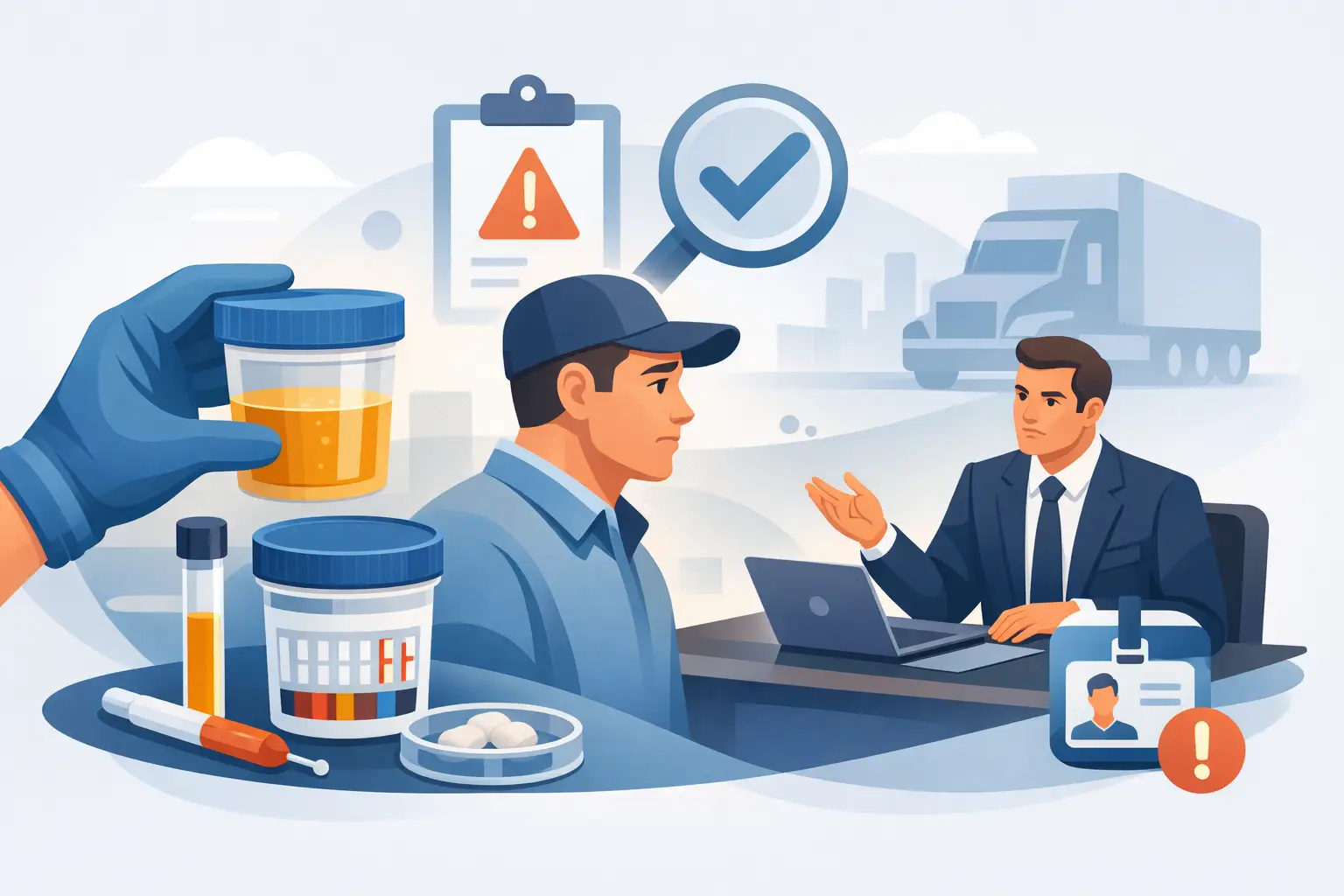
A verified positive DOT drug test creates an immediate compliance obligation, not a decision to revisit at the end of the shift. Once the employer receives notice of the verified result, the employee must be removed from DOT safety-sensitive duties. For fleet operators, DERs, and supervisors, knowing what happens after a positive DOT test helps protect public safety while keeping the response consistent, documented, and compliant.
The process is structured, but it is not automatic termination. DOT rules govern removal, evaluation, testing, and the conditions for a possible return to duty. Employer policy, collective bargaining agreements, and applicable employment laws may separately determine whether the employee remains employed.
What Happens After a Positive DOT Test?
For a DOT drug test, a laboratory result is not final simply because the lab identifies a drug or metabolite. The laboratory sends the result to a Medical Review Officer (MRO), who reviews it before reporting a verified result to the employer’s designated employer representative (DER).
The MRO makes reasonable efforts to contact the employee confidentially and gives them an opportunity to discuss a legitimate medical explanation, such as a valid prescription. Employees should respond promptly to MRO outreach. If there is no legitimate explanation that satisfies DOT requirements, the MRO verifies the result as positive and reports it to the employer.
At that point, the employer must immediately remove the employee from all DOT safety-sensitive functions. That can include operating a commercial motor vehicle, performing covered aircraft maintenance, dispatching in a covered role, operating rail equipment, or performing another duty regulated by the employee’s DOT agency.
Removal means the employee cannot perform the safety-sensitive work, even temporarily and even if the employee disputes the result. It does not necessarily mean the employer must end the employee’s employment. Some employers offer non-safety-sensitive work where policy and operational needs allow. Others may impose discipline up to and including termination under their written policy.
The employee may request split-specimen testing
For urine drug tests, the employee has the right to request testing of the split specimen after the MRO verifies a positive result. The request generally must be made within 72 hours of the MRO’s notification. The employee makes this request through the MRO, not through the collection site or the employer.
A split-specimen test is not a second collection or a retest of the original sample. It is an analysis of the sealed second portion collected at the same time as the primary specimen. The MRO will arrange for testing at another HHS-certified laboratory. The employee remains removed from safety-sensitive duties while this process is underway.
If the split specimen confirms the result, the violation stands. If it cannot be tested for a qualifying reason, the MRO follows DOT procedures to determine the appropriate outcome. Employers should avoid making assumptions and wait for the MRO’s final reporting.
The SAP Process Comes Next
Before an employee can return to DOT safety-sensitive work after a DOT drug violation, they must complete the DOT return-to-duty process. The first required step is an evaluation by a qualified Substance Abuse Professional, commonly called a SAP.
The SAP evaluates the employee and recommends education and/or treatment. The SAP does not diagnose on the employer’s behalf, decide whether the employee should keep their job, or guarantee that the employee is fit to return to a specific position. The SAP’s role is defined by DOT regulations and focuses on the employee’s compliance with the required process.
The employer must provide the employee with a list of qualified SAPs. Employers do not have to pay for the SAP evaluation or recommended services unless a company policy, contract, or benefit plan says otherwise. What employers cannot do is bypass the SAP process and allow a previously prohibited employee to resume DOT safety-sensitive duties based on a negative test alone.
After the employee completes the SAP’s recommendation, the employee returns to the same SAP for a follow-up evaluation. If the SAP determines the employee has complied, the SAP sends a written follow-up evaluation report to the employer. That report allows the employer to consider the next step, but it does not itself authorize safety-sensitive work.
Return-to-duty testing is observed
If the employer chooses to return the employee to a DOT safety-sensitive position, the employee must complete a directly observed return-to-duty drug test with a negative result. The employer must receive the negative result before putting the employee back into a safety-sensitive role.
The return-to-duty test is a single required test. It is separate from the follow-up testing plan. A negative result does not erase the prior violation or end the employer’s reporting and recordkeeping responsibilities.
The employer has discretion over whether to return an employee to safety-sensitive work after the required steps are complete, unless another agreement limits that discretion. DOT regulations require a compliant pathway for a return to duty, but they do not require an employer to offer reinstatement.
Follow-Up Testing Is a Long-Term Obligation
When the SAP issues the follow-up testing plan, the employer is responsible for carrying it out. The plan requires at least six unannounced follow-up tests during the first 12 months after the employee returns to safety-sensitive duties. A SAP may require testing for up to 60 months.
These tests are in addition to the employer’s normal random testing program. They must be unannounced, and the employer should not tell the employee when they will occur. Follow-up testing is tied to the employee, not merely to one job title. If the employee moves to another DOT-regulated employer before completing the plan, coordination and record transfer are critical.
A compliant program tracks the dates, test types, results, and remaining plan requirements without disclosing confidential medical details beyond what is necessary. Missed follow-up tests, incorrect test procedures, or poor documentation can create a serious compliance issue during an audit or investigation.
Clearinghouse Reporting for FMCSA Employers
For FMCSA-regulated drivers, a verified positive DOT drug test must be reported to the FMCSA Drug and Alcohol Clearinghouse by the appropriate party within the required timeframe. The record places the driver’s Clearinghouse status in prohibited status until the return-to-duty process is completed and reported.
Employers must also conduct the required Clearinghouse queries before hiring drivers and annually for current drivers. A query that reveals a prohibited status means the driver cannot perform FMCSA safety-sensitive functions. This is why prompt reporting, accurate DER information, and clear communication between the testing provider, MRO, C/TPA, and employer matter.
Other DOT agencies have their own recordkeeping and reporting expectations. Employers should apply the requirements for their regulated mode, whether FMCSA, FAA, FTA, FRA, PHMSA, or USCG, rather than assuming one agency’s process applies across every operation.
Do Not Confuse a Positive Drug Test With an Alcohol Violation
DOT alcohol testing follows a different path. A confirmed alcohol concentration of 0.04 or greater requires immediate removal from safety-sensitive duties and a referral to a SAP. The employee must complete the return-to-duty process before resuming covered work.
A confirmed alcohol concentration of 0.02 to 0.039 does not trigger the SAP process under DOT rules, but the employee still cannot perform safety-sensitive duties for at least 24 hours. Employer policy may impose additional consequences. A refusal to test is treated as a DOT violation and generally carries the same removal and SAP requirements as a positive drug test.
Supervisors should not label an employee as having a positive alcohol test based on observation alone. Reasonable suspicion observations may trigger testing, but the documented test result and applicable DOT threshold determine the required next step.
Build the Response Before a Test Result Arrives
The most effective response begins before a positive result occurs. Employers should identify the DER, maintain current contact details, train supervisors on post-accident and reasonable suspicion procedures, and keep a clear written policy covering employment consequences. The policy should distinguish between DOT-mandated steps and company decisions.
A reliable testing and compliance partner can help coordinate collections, MRO reporting, SAP referral information, Clearinghouse administration, and follow-up testing schedules. However, the employer remains responsible for timely removal from safety-sensitive duties and for acting on the information it receives.
A positive DOT result is disruptive, but a rushed or inconsistent response creates a second problem. Follow the required sequence, document each action, protect confidentiality, and make employment decisions under a policy that is clear before the moment of pressure arrives.





Leave A Comment