
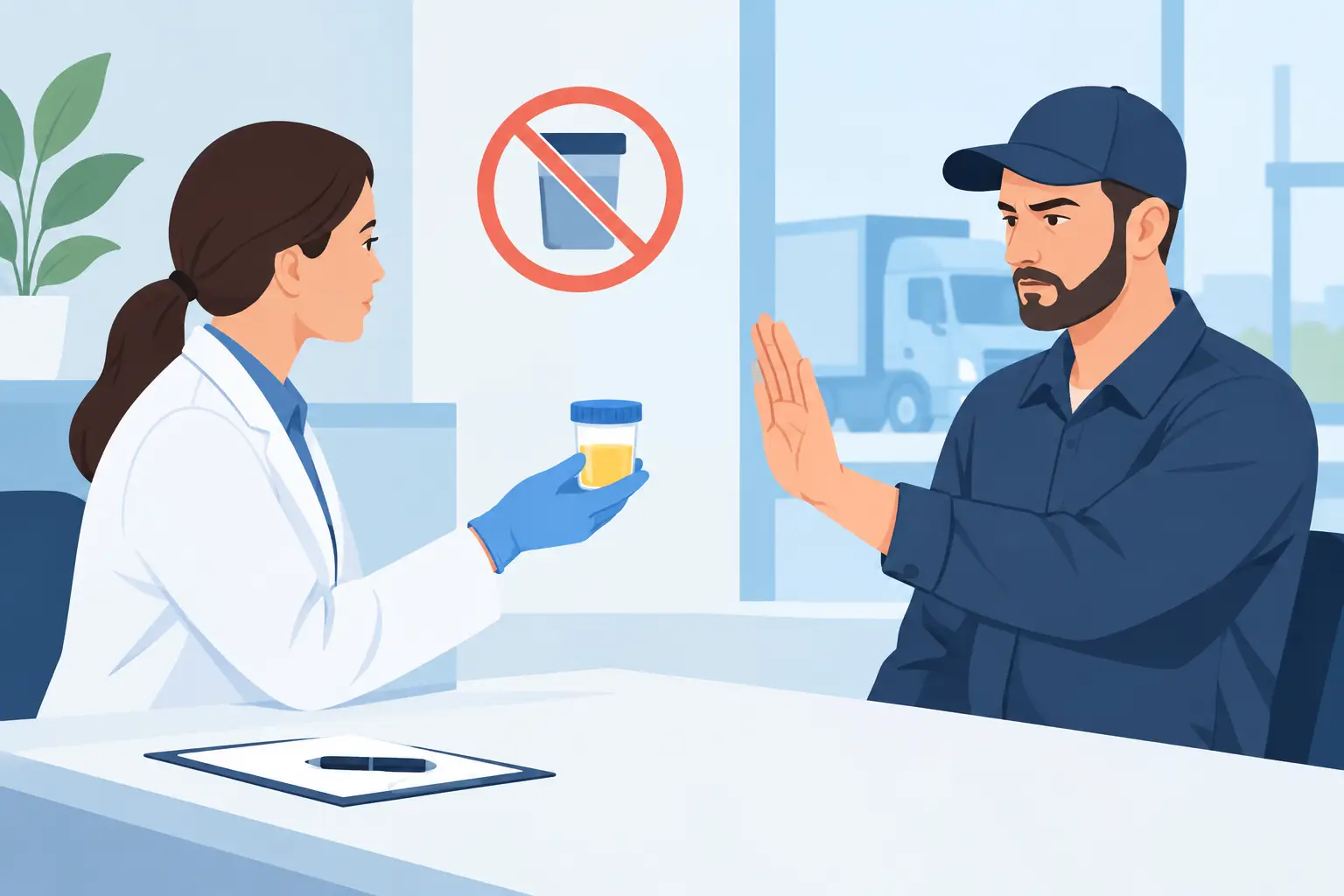
A refusal case can stop a driver, pilot, rail employee, or other safety-sensitive worker from performing regulated duties immediately. The operational challenge is not simply arranging a replacement test. Knowing how to handle refusal cases means protecting public safety, treating the employee fairly, preserving records, and following the correct DOT process from the first report.
A refusal is a serious DOT testing violation. It carries the same immediate safety-sensitive work restrictions as a verified positive drug test or alcohol test result of 0.04 or higher. Employers should have a written process, trained supervisors, and a designated employer representative ready to act before an incident occurs.
What Counts as a DOT Testing Refusal?
A refusal is not limited to an employee saying, “I will not test.” Under DOT rules, certain actions or failures to act during a drug or alcohol testing process may also be considered refusals.
Examples can include failing to appear for a required test within the employer’s specified timeframe, leaving the collection site before the process is complete, failing to provide an adequate specimen without a valid medical explanation, refusing to complete required testing steps, or interfering with the collection process. Tampering, adulteration, substitution, and certain admissions involving a specimen can also lead to a refusal determination.
The details matter. A late arrival caused by unclear instructions, a medical issue affecting a specimen collection, and an employee who intentionally leaves a site are not automatically handled the same way. Do not use the word “refusal” casually or make a final determination based only on an initial phone call from a collection site.
Depending on the circumstances, the collector, breath alcohol technician, medical review officer, substance abuse professional, or employer may have a role in documenting or determining the violation. Your designated employer representative should gather the facts and follow the applicable DOT procedures before recording the outcome.
How to Handle Refusal Cases Without Delaying Compliance
A well-managed response should be prompt, consistent, and documented. The goal is to remove uncertainty while preserving a clear record of what occurred.
Remove the employee from safety-sensitive duties
Once a DOT refusal has been determined, the employee must be immediately removed from safety-sensitive functions. Do not allow the individual to drive a commercial motor vehicle, dispatch safety-sensitive transportation operations, perform covered maintenance, or resume any other regulated duty until they complete the required return-to-duty process.
This removal is not a disciplinary decision by itself. It is a federal compliance requirement. Your company policy may address employment consequences separately, but DOT qualification rules still apply regardless of whether the employee remains employed.
For a pending situation where the facts are still being reviewed, use caution. The appropriate action can depend on the type of test, the reason for the issue, the agency rules that apply, and the information provided by the testing professional. When uncertain, pause safety-sensitive work and obtain compliance guidance promptly.
Document facts, not assumptions
Your records should tell a clear timeline. Note when the employee was notified, how they were directed to test, the collection site information, the scheduled reporting time, communications with the employee, and the exact event reported by the testing personnel.
Avoid subjective wording such as “employee was uncooperative” without supporting detail. Instead, record observable facts: the employee arrived at a specific time, left before collection was completed, declined to sign a required form, or did not report after receiving notice.
Keep testing records, chain-of-custody documentation, collector notes, alcohol testing forms, and related employer communications together according to DOT recordkeeping requirements. Accurate records support consistent decisions, audit readiness, and proper reporting.
Confirm whether a medical evaluation is required
Some refusal scenarios require additional review before the case is final. For example, an employee who cannot provide a sufficient urine specimen may need a medical evaluation coordinated through the medical review officer. An employer should not assume that an inadequate specimen is a refusal before the required process is complete.
The same principle applies when an employee claims a medical emergency, a collection-site issue, or confusion about instructions. Gather the facts quickly, but allow the appropriate testing professional to complete the required determination. Rushing this step can create unnecessary exposure for the employer and the employee.
Complete required agency reporting
For FMCSA-regulated employers, refusals must be reported to the Drug and Alcohol Clearinghouse as required. Employers must report a refusal to test by the close of the third business day after determining that the refusal occurred. Ensure the report identifies the correct driver and violation type, and keep supporting documentation in your program records.
Other DOT agencies have their own program and recordkeeping requirements. A refusal may affect an employee’s eligibility under FAA, FTA, FRA, PHMSA, or USCG rules even where Clearinghouse reporting does not apply. Employers with mixed operations should not assume one workflow fits every covered employee.
A C/TPA can help coordinate administrative steps, but the employer remains responsible for ensuring required actions and reporting are completed accurately and on time.
Start the Return-to-Duty Process Correctly
An employee who refuses a DOT test cannot simply take another test the next day and return to work. A new test does not erase the refusal.
Before returning to a safety-sensitive role, the employee must be evaluated by a DOT-qualified substance abuse professional, commonly called an SAP. The SAP will recommend education and/or treatment based on the evaluation. After the employee completes the recommended program, the SAP conducts a follow-up evaluation to determine whether the person is eligible to proceed to return-to-duty testing.
The employer then arranges a directly observed return-to-duty drug test or the appropriate alcohol testing process, depending on the violation. A negative return-to-duty result is required before the employee can resume safety-sensitive duties. The employee must also complete a follow-up testing plan established by the SAP.
The follow-up plan is not optional and cannot be replaced by the employer’s standard random testing program. It involves a minimum number of unannounced tests over a defined period, with the exact schedule set by the SAP. Maintain strict confidentiality while ensuring supervisors and program administrators know whether the employee is cleared for duty.
Prevent Refusals Before They Happen
Many refusal cases are preventable. Supervisors need more than a phone number for a collection site. They need to understand when a test is required, how to notify an employee, what instructions to provide, and what to do if the employee hesitates or raises a concern.
For random testing, communicate the requirement privately and clearly. Tell the employee where to go, when to report, and that they must remain available until released from the testing process. Do not give instructions that create avoidable confusion, such as sending an employee to a site without confirming hours, authorization details, or after-hours availability.
For post-accident testing, medical care always comes first. Once the employee is medically stable, begin the testing process as soon as practicable and document any delays. Supervisors should never advise an employee to consume alcohol, leave the scene without direction, or take actions that interfere with required testing.
Reasonable-suspicion situations require particular discipline. Only trained supervisors should make reasonable-suspicion determinations, and they should document specific, contemporaneous observations rather than conclusions. A calm, respectful explanation of the testing requirement can reduce escalation without weakening the employer’s position.
Build a Consistent Response Team
Refusal cases often become difficult when responsibility is unclear. The supervisor may be at a job site, the collection facility may be closing, and the designated employer representative may need to verify program rules after normal business hours. Assign roles in advance for supervisors, HR, safety personnel, and your testing program administrator.
Your process should identify who can authorize a test, who receives collection-site notifications, who removes an employee from duty, who manages DOT reporting, and who initiates SAP referral information. A reliable testing partner can help employers coordinate collection access, documentation, reporting support, and after-hours response, but internal decision-makers should still understand their responsibilities.
WOOTS supports employers with DOT program administration, testing coordination, supervisor training, and broad collection-site access so response procedures are easier to execute when time matters.
A refusal case is rarely the moment to improvise. Clear instructions, trained supervisors, timely documentation, and a dependable compliance process give your organization the best chance to protect safety while handling each employee situation fairly and correctly.








Leave A Comment