
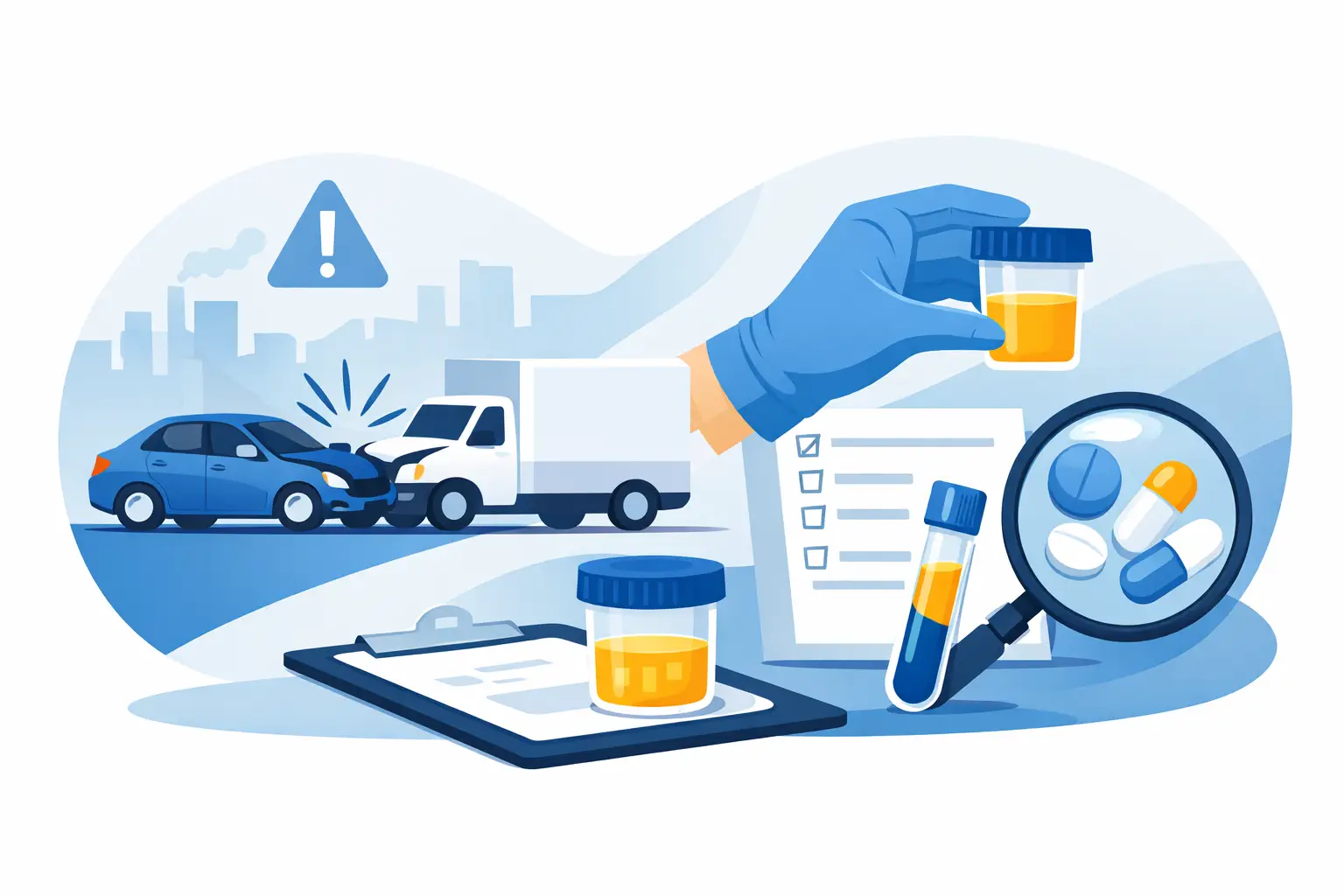
When a serious crash happens, the clock starts immediately. Supervisors are managing medical care, vehicle recovery, customer impact, insurance notifications, and regulatory reporting all at once. In that moment, post accident drug testing requirements cannot be treated as an afterthought. The decision to test, the timing, and the documentation all need to line up with the rules that apply to your operation.
For regulated employers, that usually means understanding the difference between DOT-mandated testing and employer policy. For everyone else, it means having a written process that supervisors can follow under pressure. The biggest problems do not usually come from bad intent. They come from delays, assumptions, and inconsistent decisions made after an incident.
What post accident drug testing requirements actually cover
Post accident testing is not a blanket rule that applies every time there is a fender bender or property damage claim. Whether testing is required depends on the regulatory framework, the type of employee involved, and what happened in the event itself.
Under US DOT rules, post-accident drug and alcohol testing is tied to specific triggers in each agency’s regulations. A commercial motor vehicle crash under FMCSA rules, for example, does not automatically require testing in every case. The outcome of the accident matters. Fatalities, citations, disabling damage, and injuries requiring immediate medical treatment away from the scene can all affect whether testing is required.
Outside the DOT framework, employers may still choose to test after an incident, but those decisions should be grounded in a lawful written policy. That is especially important for multi-jurisdiction employers operating in the US and Canada, where the legal standard for workplace testing can differ significantly. A post-accident testing rule that works in one setting may create legal exposure in another.
DOT post accident drug testing requirements by trigger
For DOT-covered employers, the first question is never, “Do we want to test?” The first question is, “Does the applicable regulation require testing here?” That answer depends on the agency.
FMCSA
FMCSA post-accident rules are among the most commonly misunderstood. Testing is required after a fatality, regardless of citation. Testing is also required when the driver receives a citation within 32 hours for the accident and the crash involved either bodily injury with immediate medical treatment away from the scene or disabling damage to a motor vehicle requiring tow-away.
That means not every tow-away triggers testing. Not every injury triggers testing. And if there is no qualifying citation in the non-fatal scenarios, the DOT test may not be required under FMCSA rules.
Other DOT agencies
FAA, FTA, FRA, PHMSA, and USCG each have their own post-accident or post-incident definitions and thresholds. Some are event-based. Some are tied to operational impact, injury severity, or damage criteria. Some also include mandatory employer determinations tied to covered employee performance.
This is where many employers get into trouble by applying one agency’s rule across all programs. A company that manages multiple regulated workforces cannot rely on a one-size-fits-all accident response checklist. The trigger for a truck driver may not match the trigger for a pipeline, transit, rail, aviation, or maritime employee.
Timing rules matter as much as the testing decision
One of the most important post accident drug testing requirements is timing. A required test that happens too late can still become a compliance problem.
For DOT alcohol testing, the goal is to test within 2 hours. If that does not happen, the employer must document why. Testing should continue to be attempted for up to 8 hours after the accident. If it still cannot be completed by then, the employer must stop attempts and keep the record of the delay.
For DOT drug testing, the test should be completed as soon as practical and no later than 32 hours after the accident. If the collection does not happen within that window, the employer must stop attempts and document why the test was not administered.
Those time limits create real operational pressure. If a supervisor spends too long trying to confirm the rule, locate a collection site, or arrange transportation, the employer can lose the testing window. That is why written procedures, after-hours support, and immediate access to a collection network matter so much in post-accident situations.
When you should not delay the process
Medical attention comes first. If the employee needs emergency care, that takes priority. But once immediate medical needs are addressed, avoid preventable delays.
Supervisors should not wait for a full internal investigation before starting the testing process. They also should not assume that a citation decision will be available right away. In some cases, it may be necessary to monitor the event and stay in contact with law enforcement so the employer can determine whether the testing trigger has been met within the allowed time frame.
Another frequent mistake is allowing the employee to return home or remain unsupervised before completing the required testing steps. That creates chain-of-custody concerns, alcohol-use concerns, and unnecessary administrative complications. A clear response plan reduces those risks.
Documentation is part of compliance
A post-accident test is not just a collection event. It is a documentation event.
If testing is required, the employer should document the basis for the decision, the time of the accident, when the decision was made, when collection attempts began, and whether any delays affected alcohol or drug testing timing. If testing is not required under the applicable rule, that decision should also be documented. A missing test with no supporting record is difficult to defend later.
Good records also help when there is disagreement about whether the event qualified. Insurance carriers, auditors, legal counsel, and enforcement agencies often review the same incident from different angles. A complete file shows that the employer made a timely, reasoned decision based on the rule in effect.
Non-DOT and employer policy considerations
For employers outside the DOT system, post accident drug testing requirements are usually driven by company policy, labor considerations, and applicable law. The key word is consistency.
A policy should define what qualifies as a post-accident event, who authorizes the test, what timeframe applies, and how the employer will handle refusal, transportation, and documentation. Vague language creates uneven enforcement. Uneven enforcement creates legal risk.
It also matters whether the employer is using testing as part of a broader safety program or reacting only after severe incidents. If testing appears arbitrary or disconnected from policy, it becomes harder to defend. In some jurisdictions and unionized environments, that issue is especially sensitive.
Common mistakes employers make
The most common error is assuming every accident requires a DOT post-accident test. The second is the opposite – failing to test because the situation looks minor at first and only later develops into a reportable event.
Another problem is relying on a supervisor’s memory instead of a written decision tree. Post-accident scenes are chaotic. Even experienced managers can miss a trigger when they are balancing emergency response, dispatch pressure, and customer demands.
Employers also run into trouble when they do not have an after-hours process. Accidents rarely happen on a clean weekday schedule. If your team cannot reach a program administrator, identify a collection site, or arrange testing at night or on weekends, your compliance plan is incomplete.
Finally, some employers focus only on getting the specimen and forget the larger file. If no one records the timing, the trigger, the delay reason, or the citation information, the testing event may still leave the employer exposed.
Building a response process that works in real time
The best post-accident program is not the one with the longest written policy. It is the one supervisors can actually use at 2:00 a.m.
Start with agency-specific criteria for each regulated workforce. Then build a simple internal procedure that covers who gets called, how the event is evaluated, where the employee is sent, how transportation is handled, and what records must be completed before the file is closed. Supervisor training is essential because the first few decisions often determine whether the employer stays compliant.
For organizations with broad geographic operations, collection site access and after-hours coordination are just as important as policy language. A well-written program still breaks down if there is no practical path to testing within the required window. That is why many employers work with a partner such as WOOTS to coordinate testing logistics, program administration, and documentation support across multiple locations.
Post-accident compliance is rarely about one rule in isolation. It is about making the right call quickly, documenting it clearly, and having a process that holds up under pressure when the stakes are high.

Leave A Comment