
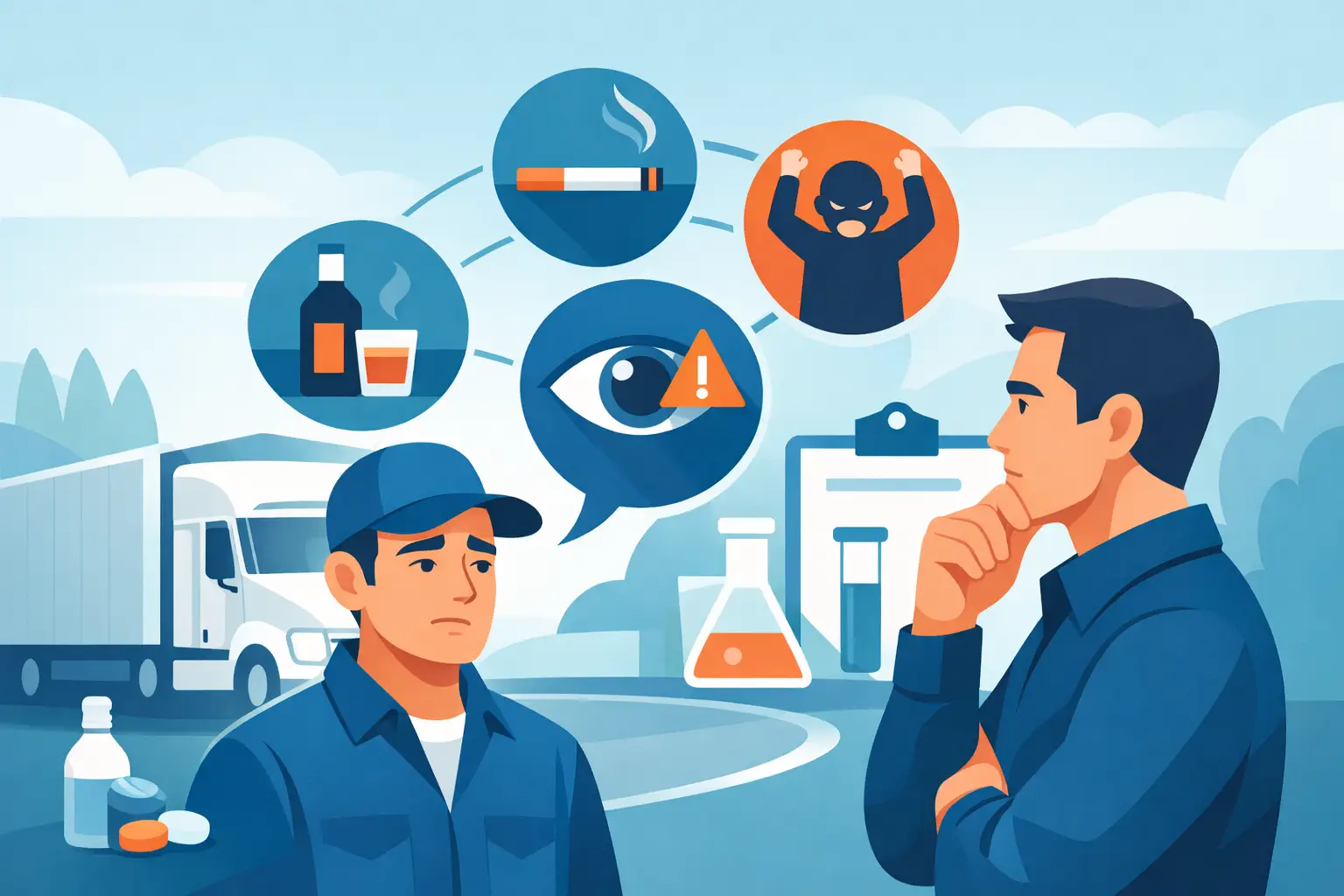
A driver arrives for a shift speaking unclearly, moving unsteadily, and carrying a noticeable odor of alcohol. That is the type of immediate, observable situation that may answer the question: what triggers DOT reasonable suspicion testing? It is not a hunch, a personality conflict, or a manager’s concern that someone seems off. It is a safety decision grounded in specific facts that a trained supervisor can clearly describe.
For DOT-regulated employers, the stakes are high. Waiting too long can expose employees and the public to risk. Acting without a compliant basis can create employee-relations problems and put the testing decision under scrutiny. A clear reasonable suspicion process helps supervisors act decisively, fairly, and consistently.
What Triggers DOT Reasonable Suspicion?
DOT reasonable suspicion testing is triggered by specific, contemporaneous, and articulable observations concerning an employee’s appearance, behavior, speech, or body odors. The observations must reasonably indicate possible prohibited drug use or alcohol misuse.
The key words are specific and contemporaneous. A supervisor must be able to explain what they personally observed at the time, rather than relying on a vague conclusion such as the employee appeared impaired. A better record would state that the employee had bloodshot eyes, slurred speech, difficulty maintaining balance, and an odor of an alcoholic beverage while reporting for duty.
The supervisor does not need to prove drug or alcohol use before ordering a test. They also should not attempt to diagnose an employee, search for a medical explanation, or debate whether the employee is impaired. Their role is to recognize observable indicators, protect the operation, follow company procedures, and document the facts.
Observations that may support a testing decision
No single sign automatically requires a reasonable suspicion test. A legitimate decision often rests on a combination of observations, particularly when they occur close together and affect a safety-sensitive employee’s ability to work safely.
Examples may include noticeably slurred, slowed, confused, or unusually loud speech; difficulty walking, standing, coordinating movements, or completing familiar tasks; dramatic and unexplained changes in behavior; glassy or bloodshot eyes; physical tremors; an odor of alcohol or marijuana; or apparent confusion and disorientation. A supervisor may also observe unsafe operation of equipment, poor judgment, or a sudden inability to follow routine directions when those concerns are accompanied by physical or behavioral indicators.
Context matters. Fatigue, illness, a prescribed medication, stress, or a personal emergency can produce some of the same signs. Those possibilities do not require a supervisor to ignore a safety concern. They do mean the supervisor should record only what they saw, heard, and smelled, without assuming the cause.
What does not establish reasonable suspicion
Reasonable suspicion cannot be based solely on rumor, an anonymous complaint, an employee’s past test result, a previous substance use issue, an arrest, or an employee’s appearance, race, age, disability, or personality. A coworker’s report can alert a supervisor to observe the employee, but it is not a substitute for the supervisor’s own documented observations.
Similarly, a manager should not use reasonable suspicion testing as a disciplinary tool or a response to poor performance alone. An employee who repeatedly misses deadlines or argues with a supervisor may need performance management, but those facts do not independently support a DOT test.
A Trained Supervisor Must Make the Call
DOT rules require the employer’s determination to be made by a supervisor or company official who has received the required reasonable suspicion training. For FMCSA-regulated employers, supervisors must receive at least 60 minutes of training on the physical, behavioral, speech, and performance indicators of probable alcohol misuse and at least 60 minutes on the indicators of probable controlled substances use.
Other DOT agencies may have additional or different program requirements, so employers should apply the rules for the agency that regulates their operation. A qualified compliance partner can help employers maintain training records and align their procedures with FMCSA, FAA, FTA, FRA, PHMSA, or USCG requirements.
The trained supervisor should make the determination based on direct observation. Although DOT rules do not universally require two supervisors, a second trained observer can be a sound company practice when available. It provides additional perspective and can strengthen documentation, especially in a disputed situation. It should not delay an urgent safety decision when a single trained supervisor has clear observations.
Responding When Suspicion Arises
The first priority is safety. If an employee is performing, about to perform, or has just performed a safety-sensitive function, remove them from that function promptly and discreetly. Do not allow the employee to drive, operate equipment, or continue safety-sensitive work while the concern is being assessed.
Next, contact the designated employer representative or follow the company’s escalation procedure. The supervisor should document observations as soon as possible, including the date, time, location, employee name, observed behaviors, statements made by the employee, and names of any witnesses. Write factual descriptions rather than conclusions. For example, record that the employee leaned against a wall for support, not that the employee was intoxicated.
The employer should then arrange the appropriate DOT test through its authorized collection process. Maintain confidentiality throughout the process. Supervisors should avoid discussing the situation with coworkers or allowing speculation to spread through the workplace.
Safe transportation is part of the response. Do not permit an employee who may be impaired to drive themselves from the worksite. Arrange a ride, contact a family member if company policy permits, or use another safe transportation option. The employer’s role is to manage an immediate safety risk, not to punish the employee at the collection site.
Drug and Alcohol Testing Have Different Time Rules
Employers should understand that reasonable suspicion drug and alcohol testing are related but not identical processes. For alcohol testing, the observation must be made during, just before, or just after the employee performs safety-sensitive functions. The employer should attempt to conduct the alcohol test as soon as practicable.
If an alcohol test is not administered within two hours after the determination, the employer must document why. If it is not administered within eight hours, the employer must stop attempts to conduct the alcohol test and prepare the required documentation. Delays should be exceptional, not routine.
Reasonable suspicion drug testing also requires specific, contemporaneous, and articulable observations. Employers should arrange collection promptly, follow their DOT procedures, and preserve documentation. Do not confuse reasonable suspicion testing with post-accident testing, return-to-duty testing, follow-up testing, or random testing. Each test type has its own trigger, timing expectations, and documentation requirements.
A reasonable suspicion alcohol result of 0.02 or greater has immediate consequences under DOT rules. A result of 0.04 or greater is a DOT alcohol violation and starts the required return-to-duty process. Drug test results must be reviewed through the DOT process, including Medical Review Officer review where required. Employers should avoid making final determinations before the formal testing process is complete.
Documentation Protects the Employee and the Employer
Good documentation is more than a compliance file. It demonstrates that the employer acted on objective safety observations rather than bias or assumption. The written record should be completed as close to the event as possible, while details are clear.
Include the precise signs observed, when and where they occurred, the safety-sensitive work involved, the name and qualifications of the supervisor making the determination, the time the employee was removed from duty, and the time testing was requested or completed. If testing could not occur within the applicable alcohol testing window, retain the required explanation.
Keep reasonable suspicion records separate from general personnel discussions and limit access to those who need the information to administer the DOT program. Confidential handling supports employee dignity and helps employers meet their recordkeeping responsibilities.
Common Mistakes That Create Compliance Risk
The most common failure is using broad labels instead of observable facts. Saying an employee looked high is not useful documentation. Describing slow responses, unsteady movement, red eyes, and the odor detected is.
Another mistake is waiting for certainty. DOT reasonable suspicion testing does not require proof, but it does require a trained supervisor with a defensible factual basis. Conversely, sending an employee for a test solely because a coworker made an accusation can create just as much risk.
Employers also create problems when supervisors are overdue for training, collection instructions are unclear after hours, or the designated employer representative cannot be reached. A written procedure is only effective if supervisors know whom to call and how to secure timely testing at any hour.
Build a Process Before You Need It
Reasonable suspicion events are stressful because they are unplanned. The best response begins well before an incident occurs: train supervisors, maintain current contact lists, identify after-hours testing support, confirm collection site access, and use a consistent observation report form.
WOOTS helps regulated employers coordinate DOT testing, supervisor training, collection access, and program documentation so teams can respond without losing time when a safety concern arises. When the facts point to reasonable suspicion, a prepared process lets your supervisors protect people, preserve fairness, and keep compliance moving forward.









Leave A Comment