
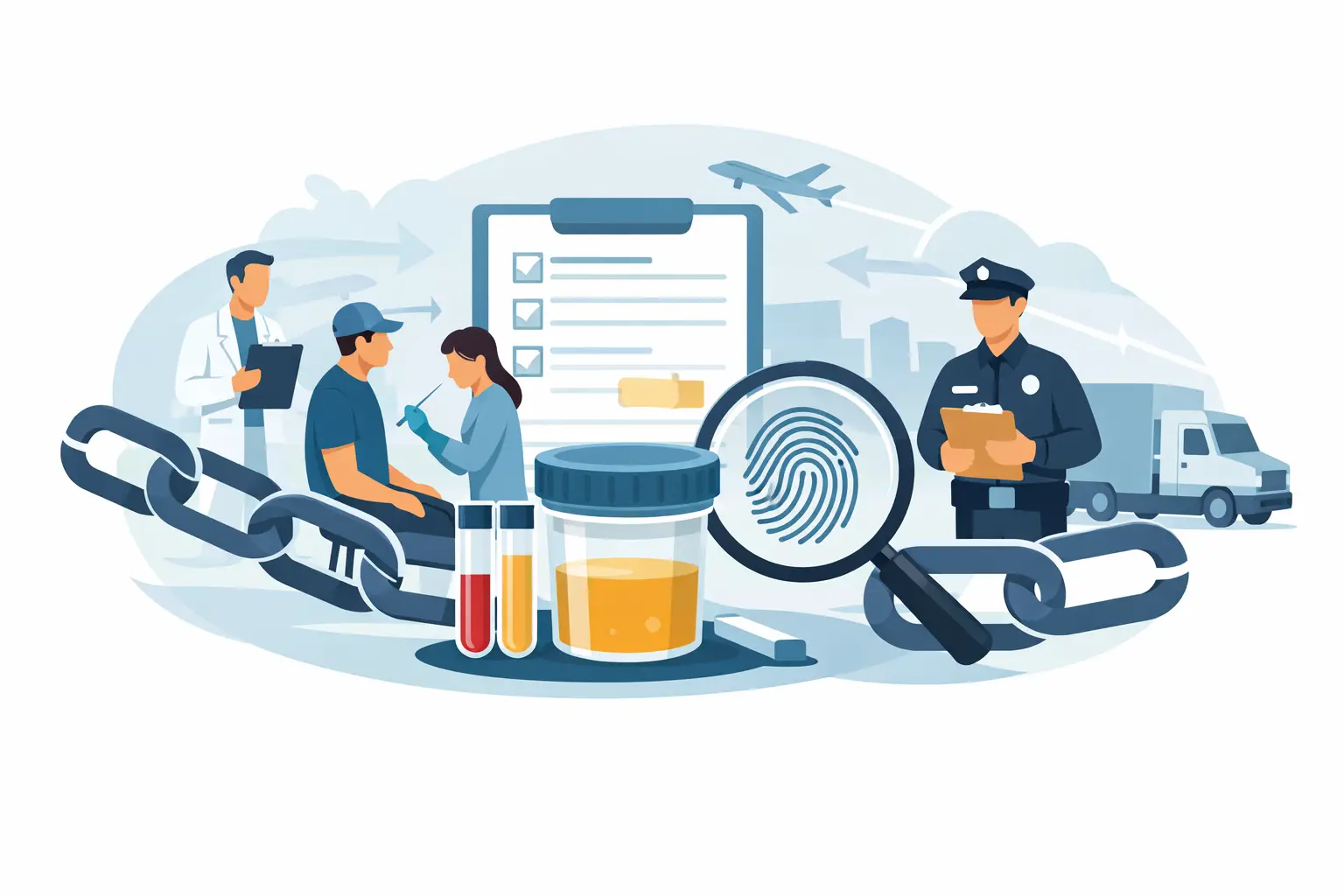
A DOT drug test can be collected on time, shipped promptly, and reviewed by the right lab and MRO – and still create a compliance problem if the paperwork trail is incomplete. That is why dot testing chain of custody matters so much. For regulated employers, owner-operators, and third-party administrators, this process is not just administrative. It is the record that connects the donor, the specimen, the lab, and the final result in a way that stands up to DOT scrutiny.
What the DOT testing chain of custody means
In DOT drug testing, the chain of custody is the documented handling of a specimen from collection through laboratory receipt, testing, and reporting. The central document is the Federal Drug Testing Custody and Control Form, often called the CCF. Every required field, signature, date, and transfer point helps show that the specimen tested is the same specimen that was collected, and that it was handled under DOT procedures.
That distinction matters because a test result is only as defensible as the process behind it. A negative result with a broken documentation trail can still raise questions. A non-negative result with an unresolved paperwork issue can create delays, cancellations, or the need for additional follow-up. For employers managing safety-sensitive workers, those delays affect staffing, dispatch, return-to-duty timelines, and audit readiness.
Why dot testing chain of custody is a compliance issue
DOT testing is procedural by design. The rules are not written around good intentions. They are written around documented, repeatable actions. The chain of custody supports that standard by proving who handled the specimen, when it changed hands, and whether the collection followed the required protocol.
For employers, this is where risk becomes practical. If a collector misses required information, if a donor does not complete the form correctly, or if a specimen seal does not match the paperwork, the issue can move from a simple correction to a fatal flaw depending on the circumstances. Some problems can be fixed through a memorandum for the record. Others cannot.
That is why experienced program managers do not treat chain of custody as a back-office detail. They build processes around it. They train supervisors on what to expect. They use qualified collection sites. They know who to call after hours if a post-accident test needs immediate support.
How the chain of custody works from start to finish
The process starts before the specimen is collected. The employer or designated service agent must order the correct DOT test under the right agency and reason for testing, such as pre-employment, random, post-accident, reasonable suspicion, return-to-duty, or follow-up. If the wrong test reason or agency is selected, the paperwork problem starts before the donor arrives.
At the collection site, the collector verifies the donor identity, explains the procedure, and begins the Federal CCF. The specimen is collected under DOT rules, split if required for urine testing, and sealed with tamper-evident labels. The donor confirms that the specimen bottles are theirs and that the seals are intact.
The collector then completes the required form sections, documenting the collection and any unusual circumstances. If there is a shy bladder situation, an observed collection, or a collection that cannot proceed normally, those details must be handled exactly as the regulations require. Small errors here can become large issues later.
Once sealed and documented, the specimen is packaged and transferred to the laboratory. That transfer is part of the custody trail. When the lab receives the specimen, it checks the package, labels, and paperwork for consistency. If there is a discrepancy, the lab may report a flaw, seek correction, or reject the specimen depending on the issue.
After testing, results move to the Medical Review Officer when required. The MRO reviews non-negative, adulterated, substituted, and invalid results, and may contact the donor to determine whether there is a legitimate medical explanation. The employer then receives the verified result through the proper reporting channel.
The most common chain of custody problems
Most chain of custody problems are not dramatic. They are routine mistakes made under time pressure. A missing signature, an incorrect date, an incomplete test reason, a mismatch between bottle seal numbers and the CCF, or use of the wrong version of a form can all trigger delays.
In practice, some issues are administrative and correctable. Others affect the integrity of the specimen itself. That difference is critical. A collector who forgets a step in documentation may be able to correct the record if DOT rules allow it. A broken seal or unidentifiable specimen is much harder to defend.
Another common issue is confusion between DOT and non-DOT testing processes. Employers operating in both the US and Canada, or across multiple workforce categories, need clean separation between regulated and employer-policy testing. If the wrong form or wrong protocol is used, the test may not satisfy DOT requirements even if a specimen was collected and analyzed.
What employers should watch closely
Employers are not expected to act as collectors or laboratories, but they are responsible for program oversight. That means they should understand where the process tends to fail and put controls around those points.
The first control is using qualified service partners who know DOT procedures and can support each testing scenario correctly. Pre-employment testing is different from post-accident response. Return-to-duty and follow-up testing require careful handling because the consequences of an error are high and timing often matters.
The second control is documentation review. Employers should confirm that records are retained properly, test reasons are documented accurately, and any correction memos are attached when allowed. If an audit happens months later, verbal explanations will not help much. The file has to speak for itself.
The third control is response planning. Chain of custody issues often surface when the employer is already under pressure, such as after an accident, during a random testing window, or when a driver is waiting on clearance to return to duty. Fast access to knowledgeable support can prevent a manageable issue from turning into an operational problem.
DOT testing chain of custody and audit readiness
Audit readiness is where the value of a clean chain of custody becomes obvious. During a DOT audit or investigation, regulators are not only looking at whether testing happened. They are looking at whether it happened correctly, on time, and with proper records.
A complete chain of custody helps demonstrate that the employer’s testing program is controlled and credible. It supports defensible decision-making if an employee is removed from safety-sensitive duty. It also protects the employer if a worker challenges the validity of a test.
There is a practical side to this as well. Strong recordkeeping reduces time spent chasing forms, clarifying collection issues, or answering preventable compliance questions. For larger fleets and multi-site employers, those time savings add up quickly.
When a chain of custody issue can be corrected
This is one of the most misunderstood parts of the process. Not every error invalidates a DOT test, but not every error can be repaired either. It depends on the nature of the flaw, where it occurred, and whether DOT rules allow corrective action.
For example, some collector documentation omissions may be addressed through a memorandum for the record. That does not mean the issue is harmless. It means there is a defined path to document and preserve the validity of the collection. On the other hand, certain fatal flaws require cancellation because the specimen cannot be reliably linked to the donor or because required procedures were not followed.
Employers should avoid guessing here. If there is a suspected chain of custody defect, it needs immediate review by qualified program support, the laboratory, the MRO, or the appropriate service agent depending on the situation. Waiting usually narrows the options.
Building a more reliable testing process
The best way to reduce chain of custody problems is to make the process easier to execute correctly. That starts with clear employer policies, trained supervisors, and testing instructions that match the actual DOT agency requirements. It also means using providers who can coordinate collection access, after-hours support, and accurate reporting without forcing the employer to manage every handoff manually.
For many regulated employers, especially those balancing FMCSA requirements with broader workplace testing needs, consistency is the real advantage. When the same compliance standards, collection procedures, and reporting expectations are applied every time, paperwork errors drop and response times improve. That is one reason companies rely on partners like WOOTS to manage the moving parts across collection sites, test events, and documentation workflows.
The chain of custody is not just a form. It is the proof that your testing program can hold up when timing is tight, scrutiny is high, and the result matters. Treat it that way before the next test is ordered, not after a flaw is discovered.







Leave A Comment